
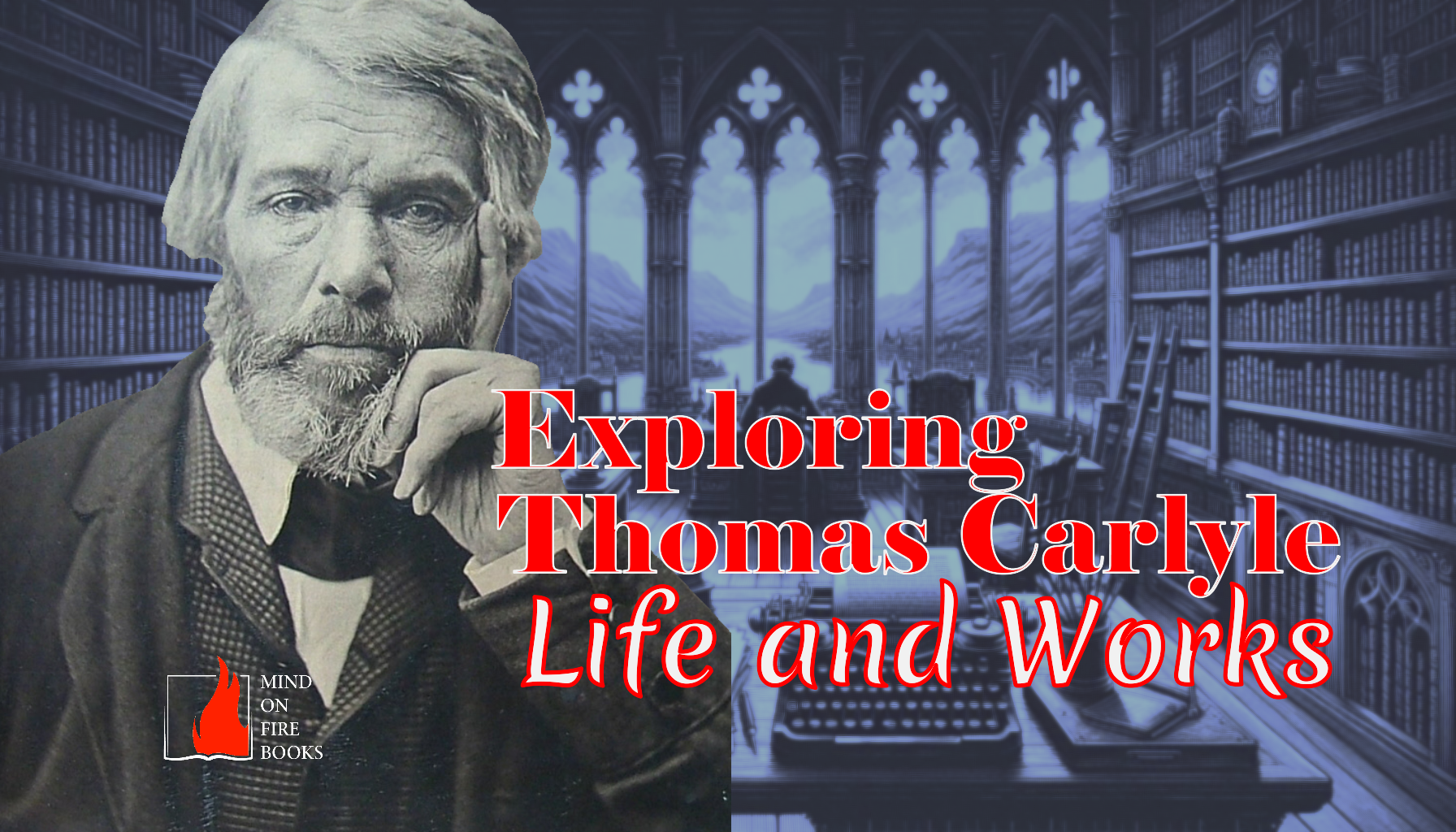
You already possess all the material from which to create your ideal self” – Thomas Carlyle
Thomas Carlyle, a towering figure in 19th-century literature and philosophy, left an indelible mark on the intellectual landscape of his time. His works, spanning historical narratives, essays, and socio-political critiques, remain a source of fascination and scholarly inquiry. This comprehensive blog delves into the life, works, and enduring influence of Carlyle, providing readers with a detailed understanding of his contributions to literature and philosophy. Article contains Affiliate Links.
Early Life and Education
Thomas Carlyle was born on December 4, 1795, in Ecclefechan, Scotland. His early life in a modest Calvinist family profoundly influenced his worldview. Carlyle’s father, James Carlyle, was a stonemason and a man of strict religious principles. This upbringing instilled in Carlyle a strong moral framework that would later permeate his writings.
Carlyle attended the University of Edinburgh with the intention of becoming a minister. However, his interest soon shifted towards literature and philosophy. The works of German writers, particularly Johann Wolfgang von Goethe, had a significant impact on him. Goethe’s exploration of human nature and society resonated with Carlyle, setting the stage for his future works. Article contains Affiliate Links.
Thank you for visiting with us. For more Writers and Rhetoric related content, visit our blog at The Ritual.
Literary Beginnings and German Influence of Thomas Carlyle
Carlyle’s early literary career was marked by translations of German literature. His translation of Goethe’s “Wilhelm Meister’s Apprenticeship” in 1824 introduced English readers to German Romanticism. Carlyle’s fascination with German literature extended to the works of Friedrich Schiller and Jean Paul Richter, whose philosophical and literary styles influenced his own.

Key Work: “Sartor Resartus” (1836)- by Thomas Carlyle
Carlyle’s breakthrough came with “Sartor Resartus,” a satirical and philosophical novel that defies traditional narrative structure. Presented as the fragmented and annotated writings of a fictional German philosopher, Diogenes Teufelsdröckh, the book explores themes of existential crisis and transcendence. Carlyle uses the metaphor of clothes to examine the nature of human existence and the pursuit of truth.
Quote from Sartor Resartus: “What is man? He endures but for an hour, and is crushed before the moth. Yet in his heart there is a Soul, and that inextinguishable voice speaks.” – Thomas Carlyle
Historical Works: Reviving the Past
Carlyle’s historical writings established him as a preeminent historian. He believed that history should not merely recount events but should provide moral guidance. His narratives are imbued with a sense of urgency and moral purpose, emphasizing the importance of individual heroes in shaping history.
Key Work: “The French Revolution: A History” (1837) by Thomas Carlyle
“The French Revolution” is a vivid and dramatic retelling of the tumultuous period in French history. Carlyle’s narrative style, characterized by vivid imagery and emotional intensity, brings the revolution to life. He portrays the revolution as a chaotic and transformative force, driven by the actions and decisions of individuals.
Quote from The French Revolution: “The history of the world is but the biography of great men.”

Key Work: “Oliver Cromwell’s Letters and Speeches” (1845)
Carlyle’s fascination with historical figures continued with his work on Oliver Cromwell. Through meticulous research and selection of letters and speeches, Carlyle presents Cromwell as a complex and often misunderstood figure. His portrayal challenges contemporary negative perceptions and emphasizes Cromwell’s leadership and moral integrity.
Socio-Political Critiques
Carlyle’s engagement with contemporary socio-political issues is evident in his essays and polemical works. He was a vocal critic of industrialization and modern capitalist society, which he believed led to spiritual and moral decay.
Thank you for visiting with us. For more Writers and Rhetoric related content, visit our blog at The Ritual.
Key Work: “Past and Present” (1843) by Thomas Carlyle
In “Past and Present,” Carlyle contrasts the harmonious and communal life of medieval England with the alienation and strife of industrialized 19th-century Britain. He advocates for a return to traditional values and a more just and equitable society.
Quote: “Work is the grand cure of all the maladies and miseries that ever beset mankind.”
Key Work: “The Latter-Day Pamphlets” (1850)
These essays reflect Carlyle’s frustration with contemporary political and social issues. He critiques democracy, which he saw as corrupt and ineffective, and advocates for strong, virtuous leadership. His views sparked controversy but also resonated with those disillusioned by the status quo.
Quote from The Latter-Day Pamphlets: “Democracy, which means despair of finding any Heroes to govern you, and contented putting up with the want of them.”
Influence and Legacy – Exploring Thomas Carlyle: Life and Works
Carlyle’s influence extended beyond literature to political thought and social reform. His ideas inspired the likes of Ralph Waldo Emerson and John Ruskin, who found in Carlyle’s works a call for ethical living and societal reform. Carlyle’s concept of hero-worship, the belief in the decisive role of great individuals in history, continued to shape historical and philosophical discourse.
Carlyle’s critical approach to contemporary issues laid the groundwork for future social critics and reformers. His writings on work, leadership, and morality remain relevant in discussions on ethics and societal values.

Personal Life and Relationships
Carlyle’s personal life was marked by his marriage to Jane Welsh Carlyle, a woman of considerable intellect and literary talent. Their relationship, though often strained, provided both mutual support and intellectual companionship. Jane’s letters offer a poignant glimpse into their domestic life and Carlyle’s complex personality.
Exploring Thomas Carlyle: Life and Works – In Review
Thomas Carlyle’s legacy as a writer, historian, and social critic is enduring. His works continue to be studied for their literary merit and their profound insights into human nature and society. Carlyle’s passionate engagement with the world around him, his fearless critique of contemporary issues, and his belief in the power of individuals to shape history make him a figure of enduring relevance.
As we navigate the complexities of the modern world, Carlyle’s call for moral integrity, purposeful work, and ethical leadership resonates more than ever. His life and writings remind us of the importance of striving for truth and the impact that one individual can have on the course of history.
References
- Thomas Carlyle. Sartor Resartus. Oxford University Press, 2008.
- Thomas Carlyle. The French Revolution: A History. Penguin Classics, 1989.
- Carlyle, Thomas. Past and Present. Cambridge University Press, 2010.
- Heffer, Simon. Moral Desperado: A Life of Thomas Carlyle. Phoenix, 1995.
- Kaplan, Fred. Thomas Carlyle: A Biography. University of California Press, 1993.
Copyright © 2024 By Mind on Fire Books
Thank you for visiting with us. For more Writers and Rhetoric related content, visit our blog at The Ritual.





Leave a Reply