
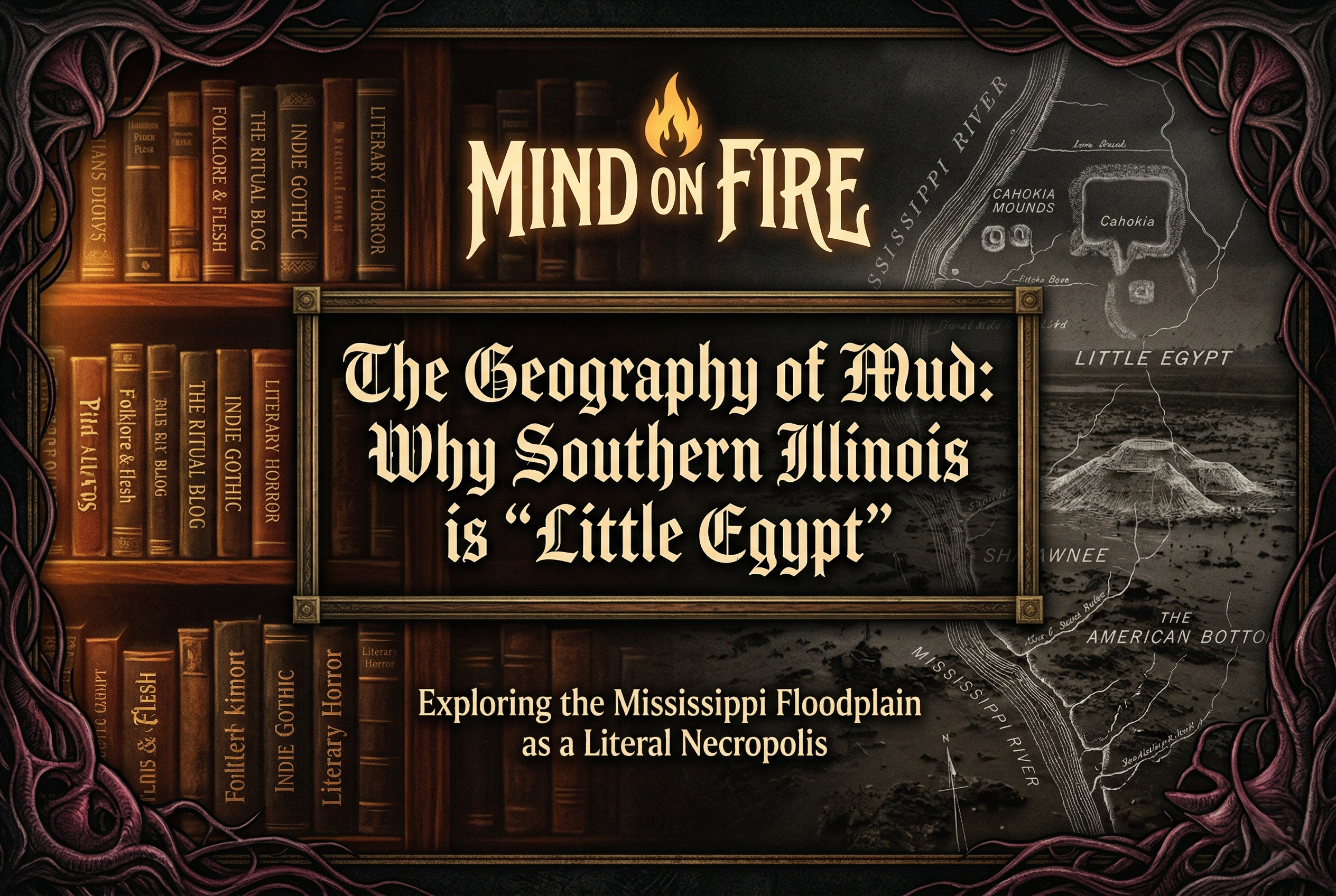
In the shadowed confluence where the Mississippi and Ohio Rivers meet, the earth holds a memory that the history books have tried to scrub clean. To the uninitiated, the region known as the American Bottom is a fertile floodplain.
For over a century, the moniker “Little Egypt” has been used to describe this tip of Southern Illinois. While most attribute the name to a 19th-century famine that sent northern settlers south for grain—mirroring the biblical trek to Egypt—the truth buried in the silt is far more ancient. In fact, it is also far more unsettling.

The Delta Delusion: Why “Little Egypt”?
The landscape of the American Bottom is a mirror image of the Nile Delta. It is a land defined by its rivers, its alluvial soil, and its propensity for swallowing what is left behind. When the first surveyors arrived, they didn’t just find rich farmland. Instead, they found a geometry that defied their understanding of the “New World.”
Towns were christened with names that hummed with desert resonance: Cairo, Thebes, Karnak, and Dongola. This wasn’t merely a poetic choice by weary settlers. It was a recognition of a landscape dominated by massive, earthen pyramids aligned with the celestial bodies above.
A Necropolis in the Mud
The core of American Bottom History is inextricably linked to the Mississippian culture, a civilization that built a metropolis of mounds—massive earthen structures that served as both temples and tombs. These were not random heaps of dirt. In fact, according to research unearthed by the contributors here, these mounds align with the belt of Orion. This creates a terrestrial star chart that mirrors the Pyramids of Giza.

Key Insights: The Geometry of the Bottoms
- The 93 Current: Occult records suggest a ley line, or “Current 93,” runs through the heart of the bottoms, acting as a frequency for the “New Aeon” of destruction and creation.
- Directive 93: In the late 1800s, agents from the Smithsonian Institution conducted extensive excavations across the Ware dig sites. Thousands of skeletons—some reportedly eight feet tall with double rows of teeth—were crated and vanished into the archives under the redacted Directive 93.
- The Unnatural Soil: Land deeds belonging to the infamous Nellie Cato lineage describe the local soil composition as “unnatural,” a medium that doesn’t just grow corn, but ripens “vessels” for ancestral return.
Creative Reflection: Mapping the Unseen
For modern creatives, the American Bottom offers a masterclass in atmospheric world-building. It reminds us that horror is most effective when it is rooted in reality. The “negative space” of the woods, the sulfurous scent of the river mud, and the “committee” of vultures watching from the oaks are more than just tropes—they are the sensory data of a land that refuses to stay buried.
Creatives can remix these ideas by looking at their own local geography through a “necropolitical” lens. What does your soil remember? What history was curated out of your local library?

Discover the Lore
The mysteries of the American Bottom and the visceral transformations of Folklore and Flesh are just the beginning. Whether you are navigating the Smithsonian conspiracies of “Little Egypt” or peeling back the skin in our latest anthology, The Ritual Blog is your portal to the uncanny.
Are you ready to witness the harvest?
- Step into the transformation with the Digital Fangs Sample Chapter.
- Uncover the redacted truth in the Directive 93 Teaser.
- Support indie dark fiction by picking up a signed copy of Folklore and Flesh.
Thank you for visiting with me. For more Poetry or Literature related content, visit my blog at The Ritual.
Based on your taste in literature, I think we could be good friends. Sign up below for the archive below and free eBook giveaways.





Leave a Reply