
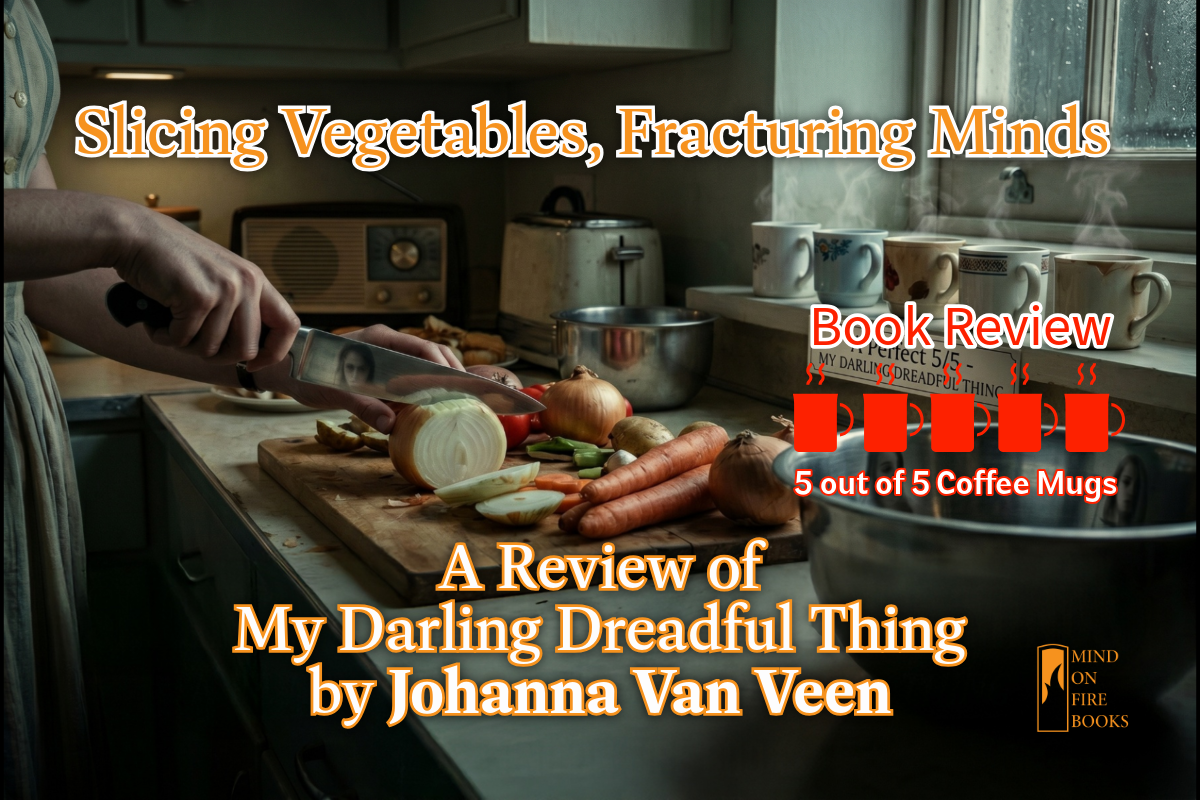
I spent last month trapped in a haunting. Not a literal one—at least, I don’t think so—but the sonic, suffocating architecture of a modern gothic masterpiece called My Darling Thing by Johanna Van Veen.
I experienced this psychological descent via my Audible subscription, letting the narrator’s performance fill the room through my Alexa for weeks while standing in my kitchen, chopping onions and prepping meals. There is something deliciously subversive about engaging with the sublime terror of a fractured mind while performing the most mundane domestic rituals. As I sliced vegetables, the protagonist’s reality was being systematically butchered by institutional power.

Let’s not mince words: I’m handing this novel five out of five coffee mugs.
But we aren’t here just to talk about whether a book is “spooky.” We are here to dissect why it terrifies us, and what that terror reveals about the power structures we quietly submit to every single day.
The Anatomy of the Monster: Elite Deprivation
My Darling Thing starts with the carnivalesque—a young girl and her mother running low-rent seances. But the narrative quickly fractures, slamming us into the cold, clinical reality of a modern-day psychiatric evaluation. Our protagonist is on the hook for the murder of her caretaker, spinning a morbid tale about the wealthy elite, false relationships, and a “liminal being” she claims lives in the dark with her.
It is so easy, so desperately comforting, for the reader to dismiss this entity as the tragic coping mechanism of a traumatized girl. But to do so is to miss the true horror of the text.
Where do monsters come from? We like to think they crawl out of the primordial muck or cross over from the ether. But in this novel, the monster is a byproduct of capitalistic hoarding and elite deprivation. The wealthy characters treat human connection as disposable currency. They deprive this young girl of the most basic sensory and emotional nutrition—food, love, truth—stunting both her physical and mental growth.
Her “imaginary friend” is an evolutionary adaptation to systemic abuse. Whether the entity is a brilliant, defensive fracturing of a secluded mind or a literal supernatural horror born from a vacuum, it doesn’t matter. The true monsters never stay in the basement. They sit at the head of the dinner table. They wear tailored suits.
If you hunt for insights that change the temperature of the room, join the circle at The Ritual. Enter your email below to unlock the archive, grab free eBook giveaways, and ignite your library.
The Discursive Power of the Psych Ward
This brings us to the true battlefield of the novel: the interrogation room.
If we apply Michel Foucault’s theories of power to the text, the psychiatrist and the lawyer aren’t merely characters; they are the discursive network of the state. They represent empirical, objective rationalism. Their goal is not healing, but control. They are attempting to weaponize binary fear (“us vs. them,” “sane vs. insane”) to force the protagonist—and the reader—into acquiescence. If she is crazy, the state is safe, and the elite are absolved.
But our narrator engages in parrhesia—fearless truth-telling from a position of absolute powerlessness. She wholeheartedly believes in her supernatural companion. Her unwavering testimony acts as a wrench in the gears of their clinical machinery. By framing this gothic horror through an empirical, psychiatric lens rather than a religious one, the author, Johanna Van Veen makes the terror inescapable. Science cannot save us here; it only measures the depth of the abyss.

The Architecture of Hesitation
Ultimately, the brilliance of My Darling Thing lies in its mastery of Tzvetan Todorov’s concept of the “fantastic.” Todorov argued that true horror exists in the hesitation between the uncanny (it’s all in her head) and the marvelous (the ghost is real).
The novel refuses to give the institutional authorities—or us—an easy out. It traps us in that duration of uncertainty. This paralysis is exactly what Edmund Burke called the sublime—a terror so profound it strips away our logic and transports us to a primal state.
We are forced to look at our own society. We are forced to ask: How many people have we allowed our institutions to isolate? How many minds have been fractured by a system that deprives them of love, only to lock them in a room when they dare to manifest their own company?
My Darling Thing doesn’t just play with the tropes of family secrets and gothic isolation; it weaponizes them. It is a mirror held up to a society that would rather drug a victim than dismantle the elite systems that traumatized her.
Read the book. Let it agitate you. And the next time you’re cooking in the safety of your kitchen, ask yourself: who holds the keys to the locks on your doors?
Thank you for visiting with me. For more Poetry or Literature related content, visit my blog at The Ritual.



Leave a Reply