
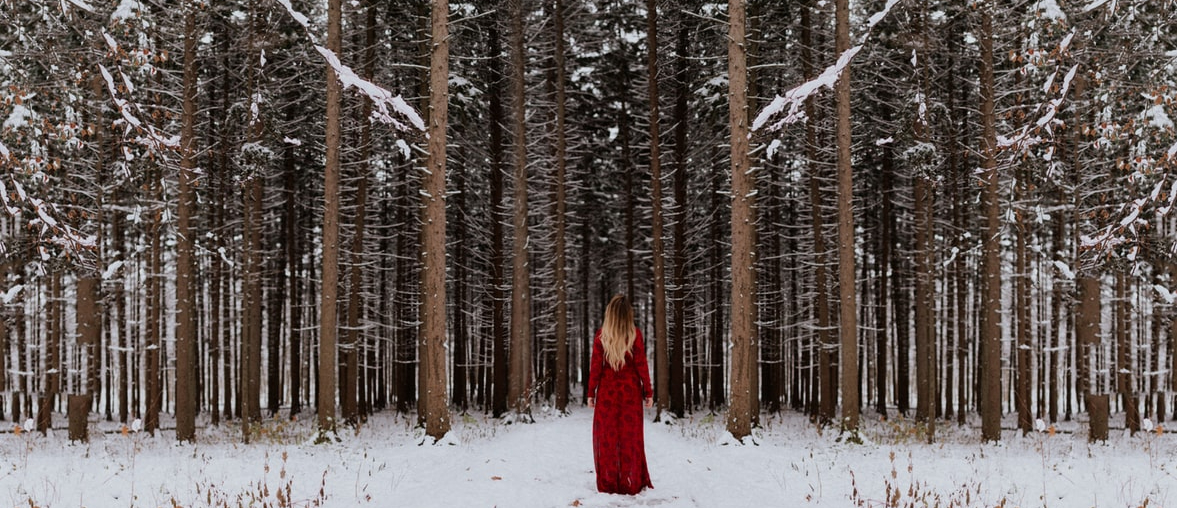
As the shortest day of the year approaches – Winter solstice – we might not be feeling any love towards the cold or the dark of the winter solstice. But poetry reminds us of the beauty in all things, even the frosty, the bitterness of December days and the Winter that lay ahead. (Header photo by Hernan Sanchez at Unsplash.)
Instead of looking upon the solstice with dread, here are three poems to remind you of the enchantment of winter, and provide you with warmth and solidarity when the icy winds blow. Post may contain affiliate links.
THE WORLD BY JENNIFER CHANG
One winter I lived north, alone
and effortless, dreaming myself
into the past. Perhaps, I thought,
words could replenish privacy.
Outside, a red bicycle froze
into form, made the world falser
in its white austerity. So much
happens after harvest: the moon
performing novelty: slaughter,
snow. One hour the same
as the next, I held my hands
or held the snow. I was like sculpture,
forgetting or, perhaps, remembering
everything. Red wings in the snow,
red thoughts ablaze in the war
I was having with myself again.
Everything I hate about the world
I hate about myself, even now
writing as if this were a law
of nature. Say there were deer
fleet in the snow, walking out
the cold, and more gingkoes
bare in the beggar’s grove. Say
I was not the only one who saw
or heard the trees, their diffidence
greater than my noise. Perhaps
the future is a tiny flame
I’ll nick from a candle. First, I’m burning.
Then, numb. Why must every winter
grow colder, and more sure?

If you are enjoying this collection on Winter Solstice Poetry, we have more great Literary content on The Ritual Blog here.
AN OLD MAN’S WINTER NIGHT BY ROBERT FROST
All out-of-doors looked darkly in at him
Through the thin frost, almost in separate stars,
That gathers on the pane in empty rooms.
What kept his eyes from giving back the gaze
Was the lamp tilted near them in his hand.
What kept him from remembering what it was
That brought him to that creaking room was age.
He stood with barrels round him—at a loss.
And having scared the cellar under him
In clomping there, he scared it once again
In clomping off—and scared the outer night,
Which has its sounds, familiar, like the roar
Of trees and crack of branches, common things,
But nothing so like beating on a box.
A light he was to no one but himself
Where now he sat, concerned with he knew what,
A quiet light, and then not even that.
He consigned to the moon—such as she was,
So late-arising—to the broken moon
As better than the sun in any case
For such a charge, his snow upon the roof,
His icicles along the wall to keep;
And slept. The log that shifted with a jolt
Once in the stove, disturbed him and he shifted,
And eased his heavy breathing, but still slept.
One aged man—one man—can’t keep a house,
A farm, a countryside, or if he can,
It’s thus he does it of a winter night.

Robert Frost was born on March 26, 1874, in San Francisco, where his father, William Prescott Frost Jr., and his mother, Isabelle Moodie, had moved from Pennsylvania shortly after marrying. After the death of his father from tuberculosis when Frost was eleven years old, he moved with his mother and sister, Jeanie, who was two years younger, to Lawrence, Massachusetts. He became interested in reading and writing poetry during his high school years in Lawrence, enrolled at Dartmouth College in Hanover, New Hampshire, in 1892, and later at Harvard University in Boston, though he never earned a formal college degree. Excerpt is taken from Poets.org.

If you are enjoying this collection on Winter Solstice Poetry, we have more great Literary content on The Ritual Blog here.
TO KNOW THE DARK BY WENDELL BERRY
To go in the dark with a light is to know the light.
To know the dark, go dark. Go without sight,
and find that the dark, too, blooms and sings,
and is traveled by dark feet and dark wings.


Berry has published more than eighty books of poetry, fiction, essays, and criticism, but he’s perhaps best known for “The Unsettling of America,” a book-length polemic, from 1977, which argues that responsible, small-scale agriculture is essential to the preservation of the land and the culture.  Excerpt taken from The New Yorker here.
Based on your taste in books, I think we could be great friends!





Leave a Reply