
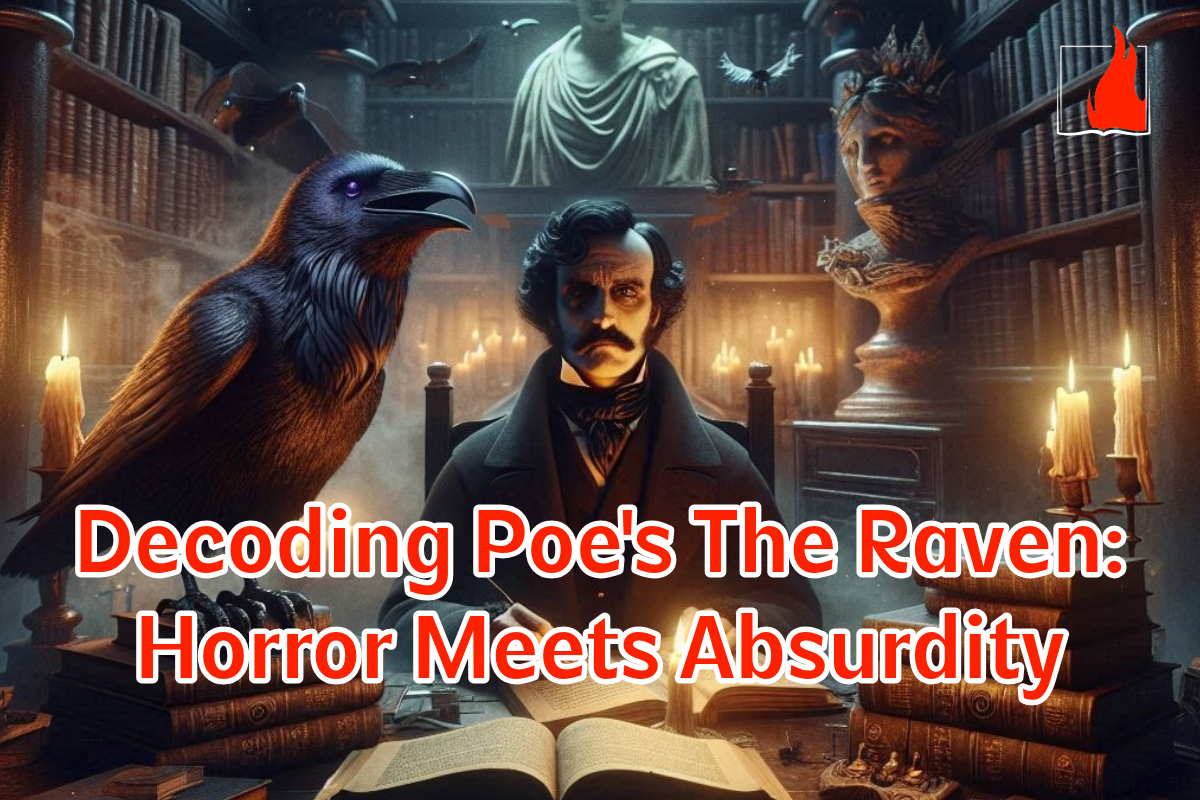
From Required Reading to Genre Domination
Once upon a midnight dreary, I submitted a lifeless academic analysis of The Raven—one that my professor had likely seen 15 times that week. It had the standard, cookie-cutter structure: awkwardly placed quotes, hollow thesis statements, and a conclusion so uninspired that it barely flickered like a dying ember.
So, you can imagine, I was not a fan of The Raven at first.
And yet, somewhere deep in my gut, I knew this poem deserved more than being dissected like a frog in a freshman lab experiment. Poe’s mastery wasn’t meant to be confined to sterile analysis—it deserved to breathe, to unsettle, to haunt.
So, I threw out the lifeless academic jargon and did what any horror-obsessed writer would do—I turned it into something people would actually want to read. A critique with bite. A conversation with Poe that didn’t feel like a regurgitated lecture.
And today, we unravel this iconic horror poem the way it should be read: with dread, wit, and the unmistakable feeling that Poe was laughing at us the whole time.
A Poem That Refuses to Die
Every generation rediscovers The Raven.
Not just because of academic coursework or high school syllabi, but because Poe’s talking bird refuses to fade into literary obscurity. The poem seeps into pop culture like a creeping fog, showing up in films, music, literature, and even a football team (Baltimore Ravens—Poe would have either loved it or found it profoundly ridiculous).
But why? Why does this particular poem have such an unrelenting grip on the collective imagination?
Because Poe understood something that many writers miss: horror isn’t just about fear—it’s about inevitability.

Absurdity Meets Horror: Poe as Kafka, Vonnegut, and Burroughs in Disguise
Too many interpretations of The Raven treat it as a funeral march, weighed down with grief and sorrow. But Poe—ever the trickster—was far too clever to let it be just a lament for lost love. This poem is absurd.
Read between the lines, and you’ll see it: this is a Kafkaesque descent into madness, wrapped in an eerie lullaby.
Consider the setup:
- A grieving scholar sits alone, mourning the death of his beloved Lenore.
- A literal talking raven enters his chamber, perches above the bust of Pallas Athena (wisdom, ha!), and refuses to leave.
- The narrator spirals into despair, begging for answers, only to be hit with the same deadpan reply:
“Quoth the Raven, ‘Nevermore.’”
Each time the narrator pleads for solace, the raven gives him the same unyielding answer. And here’s where Poe steps into dark comedy territory.
Imagine if Kafka had written this: The Raven wouldn’t be a singular event—it would be a government-mandated experience. Every citizen would have a bird perched above their door, stamping every request for joy with the bureaucratic rubber stamp of “Nevermore.”
Vonnegut would have treated this whole affair as a cosmic joke. Burroughs? He would have made the raven a drug-induced hallucination, cackling from the corner of a dilapidated hotel room.
And that’s why The Raven still works today—it’s horror with an absurdist edge.
Based on your taste in books, I think we could be great friends! Please sign up for the newsletter below:
A Conversation with Poe: The Raven as a Literary Debate
Imagine sitting across from Poe in a dim, candlelit room. The conversation between writer and reader unfolds over whiskey and smoldering cigars. Poe, ever theatrical, leans in and mutters:
And his eyes have all the seeming of a demon’s that is dreaming.”
Is this bird a messenger of doom? A figment of insanity? Or just a bird repeating what it learned?
The beauty of The Raven is that it never gives a straight answer.
Its relentless refrain “Nevermore” could mean anything or nothing—but in the context of grief, despair, and supernatural suggestion, it feels devastating.
And that, in itself, is the cruel brilliance of Poe’s design.
Featured products


Final Verdict: Poe Wins Again
Does The Raven belong in textbooks? Absolutely. But more importantly, it belongs in conversation—in late-night discussions, horror forums, campfire retellings, and even in moments when we sit alone, haunted by our own thoughts.
Poe understood what it meant to trap readers in their own minds, and he built The Raven to be inescapable.
The narrator pleads for relief. The raven denies him.
We plea for meaning. The poem denies us.
And maybe that’s Poe’s final joke—giving us a horror masterpiece that never truly lets us go.
Thank you for visiting with us. For more Reviews or Literature related content, visit our blog at The Ritual. Copyright Mind on Fire Books.
Catch us Poolside on Amazon


Spread the word

Enjoyed the Chat? Don’t Leave Without “Digital Fangs.”
Thanks for diving deep into the world of Folk Body Horror! If you want more unsettling tales where the body mutates and the land has a claim, join the Mind on Fire insider list today. As a welcome gift, I’ll send you “Digital Fangs,” a complete, dark story from the Folklore and Flesh collection—absolutely free!
GIVE ME MY FREE STORY NOW




Leave a Reply