

Every October, as the air turns crisp and the shadows stretch long, American folklore calls us back to the most iconic ghost story ever written: The Legend of Sleepy Hollow. Washington Irving’s 1820 masterpiece is frequently hailed as America’s first great ghost story. Its true terror lies in how it seamlessly wove the restless spirits of the Old World into the raw, new soil of the American imagination.
It’s not just a tale of a schoolmaster and a supernatural brute. It’s a story about the terrifying, inevitable truth that the past refuses to stay buried.
Folklore’s Bloody Lineage
Irving didn’t simply invent the idea of a headless phantom. He synthesized centuries of global dread. Tales of the Gan Ceann—the headless rider of Irish and Dutch legend who carries his own decaying skull—date back to the Middle Ages. Similar motifs appear in the Brothers Grimm tales and Norse mythology.
Yet, a more immediate influence may have been the Gothic literature of his time. Historians point to Sir Walter Scott’s 1796 translation of the German poem The Wild Huntsman. As Irving befriended Scott, it’s highly probable he is influenced by the poem. It’s about a wicked hunter doomed to be eternally hunted by the devil.
But the most potent ingredient in Irving’s cauldron of fear was the American Revolution. The common rumor, often cited by locals, suggests the Horseman is an actual Hessian soldier whose head was taken clean off by a cannonball. This event occurred during the Battle of White Plains, near Halloween in 1776. Irving took a universal fear and gave it a local, patriotic trauma.
Ghosts in the American Soil
Irving’s genius was in grounding this European legend right in the heart of the budding republic. He took his own adolescent experiences. Having fled a yellow fever outbreak in New York City to the Tarrytown region in 1798, he mixed real history with fantasy.
He peppered the narrative with factual landmarks— the Old Dutch Church, the churchyard, and real family names like Van Tassel and Ichabod Crane. This gave the myth a terrifying sense of immediacy. As historian Elizabeth Bradley notes, Irving “cleverly weaves together factual locations… with pure imagination and fantasy. It’s a melting pot of a story, and thus totally American.“
The result is a ghost story that feels anchored. It is an inescapable warning set in a landscape you can still visit today.
The Headless Horseman as Unfinished Business
Beyond the suspense of the chase—where a terrified, lanky Ichabod Crane is thrown from his horse by a pumpkin-wielding fiend—lies the deeper horror. The Horseman, as a supernatural entity, represents the past that never dies.
Franz Potter, a professor specializing in Gothic studies, explains the Horseman’s demand. He seeks retribution and a head that is unfairly taken from him. This injustice ensures he can never rest.
“The horseman, like the past, still seeks answers, still seeks retribution, and can’t rest. We are haunted by the past which stalks us so that we never forget it.”
The story forces us to confront the idea that history is not neatly filed away. It is a violent, galloping force that continuously seeks a substitute for what it lost. Ichabod’s vanishing act is the perfect symbol for this haunting. It is an American mystery that leaves the reader in permanent, terrified suspense.
The Enduring Mystery
The lasting power of The Legend of Sleepy Hollow is its refusal to provide a definitive answer. Was the Horseman a supernatural fiend, or was it the jealous rival, Brom Bones, playing a gruesome prank?
This ambiguity is the story’s greatest strength. It accommodates the changing American imagination, reminding us that some mysteries are better left unsolved. The Legend lends itself to any interpretation, ensuring that the ghostly rider will continue to fascinate and terrify us for centuries to come. The terror of the Horseman isn’t in his charge, but in his enduring, unanswered call.
What is your favorite adaptation of The Legend of Sleepy Hollow, and why? Let us know if you think Ichabod Crane was killed by a ghost or just a jealous prankster in the comments below!
Thank you for visiting with us. For more Literature related content, visit our blog at The Ritual.

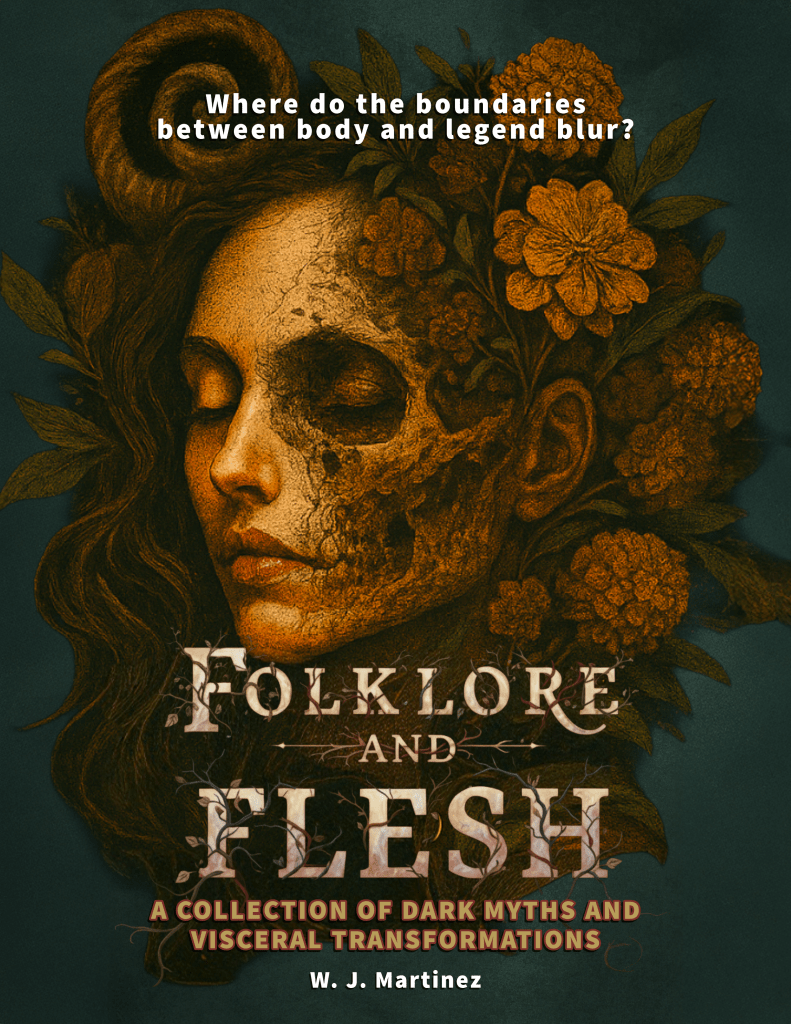
Folklore and Flesh: A Dark Fiction Collection of Folklore and Body Horror
Step into the uncanny with Folklore and Flesh—a collection of visceral horror stories and haunting poems that blur the boundaries between myth and the body. From ancient rituals and supernatural transformations to the raw ache of grief and memory, these tales invite you to explore the shadowed places where folklore becomes flesh.
This collection binds 10 creative short stories and a dozen visceral poems.
ARC Release: October 11th (Myths and Legends Day)
Presale Opens: November 20th (Blotmonath – Month of Sacrifice)





Leave a Reply