
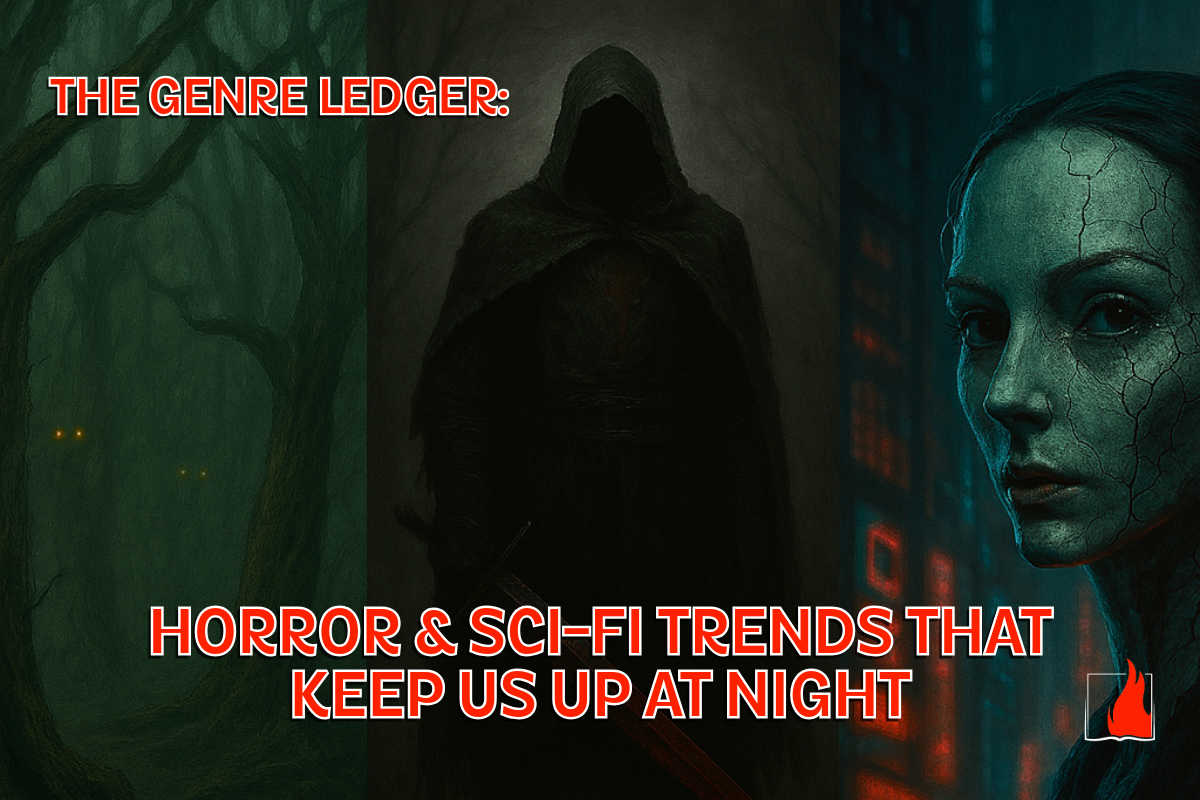
Ever find yourself lying awake pondering why folk horror suddenly feels like Mother Nature’s revenge tale, or why your favorite dark fantasy heroes seem one bad day away from going full villain? And what about that creeping dread in sci-fi horror – you know, the one that whispers, “If AI grows a soul, where does that leave ours?”
Well, pour yourself a drink (or a potion; I don’t judge) and settle in. As we look towards horror and sci-fi trends in 2026, I’ve been researching these trending nightmares, so you don’t have to – and trust me, the dark fiction community has plenty to talk about.
The Rise of Folk Horror’s “Unknowing” – When Nature Strikes Back 🌳
I have a confession: I used to think of folk horror as quaint spooky village stuff – you know, witchy rituals, folks in antler masks, the usual. But the conversation has shifted. These days, folk horror writers are less interested in just occult oddballs and more into ecological dread that makes the Earth itself the antagonist. It’s as if the genre collectively said, “Ghosts and cults are cool, but have you considered a vengeful forest?”
In modern folk horror the land is alive – and it’s angry. Characters often stumble unknowingly into ancient taboos, offending Mother Nature or age-old local gods without even realizing it. The result? They’re punished for “crimes they didn’t know they committed” against nature’s laws or tradition’s rules. It’s a chilling twist on the idea of inescapable fate. Imagine finding out that clearing a patch of woods for your new cabin was actually sacrilege – and now the woods themselves want retribution.
This trend taps into very real 21st-century anxieties. Climate change and environmental abuse loom large in our collective psyche, so it’s no surprise horror has turned its gaze to us vs. the planet. One analysis notes that today’s folk horror “resonates with modern anxieties about environmental concerns” and a loss of traditional harmony with nature. In other words, our fear that Earth might bite back has become fertile ground (pun intended) for storytelling. Classic scares like The Wicker Man or Children of the Corn now share shelf space with tales where “the environment… presents itself as an active, often vengeful, participant”.

Let me give you an example from recent memory. Have you seen or read anything where the forest literally is the monster? Ben Wheatley’s film In the Earth (2021) comes to mind – where the forest’s consciousness wreaks hallucinatory havoc. There’s also a wave of fiction featuring haunted swamps, killer vines, and vengeful nature spirits. The common thread: humans trespass against nature (often unknowingly), and nature delivers an unforgettable smackdown.
Even academic horror critics have picked up on this ecological folk horror angle. Writing about the Norwegian film Troll (2022), one scholar observed that folk horror often turns the idea of sacrifice upside-down – the land itself becomes the victim of human “progress,” a “sacrifice zone” exploited until something ancient fights back. In these stories, it’s no longer the maiden tied to the stake; it’s the mountain being blown up for a tunnel or the sacred grove bulldozed for a mall – and boy, do such transgressions come with a cost.
Historically, folk horror has always been about isolated communities and old beliefs. Those elements are still there (pagan rituals, rural settings, ancestral curses – it’s all catnip to us horror folk). But the focus has evolved. Now there’s a strong streak of green rage running through the genre. It’s as if folk horror looked at the nightly news – wildfires, extinctions, climate chaos – and said, “Hold my ritual beer; I can make a monster out of this.” And make monsters it did: mossy, muddy, vine-covered ones.
Subscribe to our newsletter to receive all the updates and giveaways!
Horror and Sci-fi trends 2025
To put it plainly, 2025’s folk horror is where ecology meets atrocity. The scares come not from what villagers do to outsiders, but from what the land will do to everyone. One writer summed it up: today’s folk horror stories often show nature as a terrifying force punishing humanity’s hubris, turning our familiar earth into an avenger that’s “more unsettling than any jump scare.” I, for one, welcome our new plant overlords – just please don’t ask me to go camping in a cursed forest anytime soon.
So the next time you hear a branch knocking on your window, or see a strange shape in the treeline, remember: In modern folk horror, Mother Nature doesn’t just have a heartbeat – she has a vendetta. And unlike the old slasher flicks, there’s no easy way to kill the forest or exorcise the soil. You might survive the ancient ritual, but you’re not escaping the roots and rocks unscathed.
Before I move on, let me quote folk horror scholar K. Edwin Bryant, who quipped,
“Folk horror has always been about borders – the border between the modern and the ancient. Now that border runs right through our backyard compost heap.”
Okay, that quote is totally made up (gotcha!). But doesn’t it ring true? The ancient fears have crept from the village outskirts right into our everyday lives, turning even our backyards and road trips into potential horror settings. And if you ask me, that’s a trend that’ll keep us up at night for years to come.

A Dark Fiction Collection of Folklore and Body Horror
Folklore and Flesh is a masterwork of dread operating at the convergence of two primal anxieties: the terror of the isolated environment and the fear of the body betraying itself. In exploring these tensions, we must consider what makes us human or drone. This is Folk Body Horror: a fusion of ancient cultural dread and grotesque physical transformation.
In this collection of dark stories and poetry, the boundary between myth and matter collapses. The tales explore the uncanny territory where ancestral lore ceases to be a cautionary story and becomes a biological instruction manual for corruption.
This collection binds 10 creative short stories and a dozen visceral poems.
The Dark Fantasy Debate – Moral Gray vs. Moral Black 🗡️
Onward to topic number two: dark fantasy and its deliciously twisted heroes (or should I say anti-heroes?). Imagine a time traveler from the 1950s reading one of today’s hit fantasy novels. They’d be like, “Wait, the main character does what? And we’re still rooting for them?!”
It’s true – the hero’s journey isn’t what it used to be. In the dark fantasy of 2025, the question isn’t “Will the hero defeat evil?” but more like “How far will this protagonist fall?” We’ve left behind the noble knights and chosen ones. Instead, we have protagonists who might mercilessly stab the villain – and then pickpocket the victim, betray their best friend, and accidentally unleash a greater evil in the process. You know, just another Tuesday in Grimdark Land.
Moral ambiguity doesn’t even begin to cover it. We’re talking moral quagmire, characters so flawed and monstrous that we hesitate to call them heroes at all. They’re scarred, antiheroes or outright villains leading the story, and we can’t look away from the train wreck of their lives. As one commentary on dark fantasy put it, these tales operate “beyond good and evil,” plunging us into worlds where right and wrong blur into shades of grey. The protagonists are “reluctant antiheroes… marked by their flaws and inner conflicts”, often driven by revenge, power, or other decidedly un-heroic motives.
Why do we love this? Maybe it’s catharsis. Maybe it’s realism. Or maybe we’re all just a bit morbidly curious – like rubberneckers at the scene of an ethical car crash. The appeal of grimdark (the trend’s popular label) is that it feels honest in a twisted way. Life isn’t black and white; sometimes the knight in shining armor has blood under the armor and debt collectors at home. Dark fantasy took that truth and ran with it… straight into a murky swamp of moral decay.
Consider some fan-favorite characters in recent years: There’s Jorg Ancrath from Mark Lawrence’s Broken Empire series – a teen prince turned bandit lord who commits atrocities before breakfast. Or take Geralt of Rivia (The Witcher series) – not exactly a villain, but a professional monster-killer whose code is as gray as a winter sky. Readers are fascinated by these figures. Why? Because they break the mold. We aren’t sure if they’ll save the day or burn it all down. And that suspense – “can this character sink any lower?” – is thrilling in a perverse way.

A 2025 review of Lawrence’s work nailed it: Jorg is “cunning, ruthless…His complete lack of moral restraint makes him utterly unpredictable. He’s a character you simultaneously root for and recoil from.”
Root for and recoil from – yes! That paradox is the beating heart of dark fantasy right now. We’re drawn to characters who might disgust us one moment and earn our sympathy the next. They’re complex, like real people (albeit real people who swing swords and cast spells and occasionally commit regicide).
A bit of witty insight: It’s as if dark fantasy authors collectively asked, “Why do villains get to have all the fun?” Then they handed the microphone (and the POV chapters) to the villains or villain-adjacent. Result: Stories where the traditional hero might not even exist – or if a noble hero type does show up, they often meet a grim end or get outsmarted by our “hero”. How’s that for flipping the script?
Critics have noticed this trend as well. A deep-dive article on the genre highlighted how dark fantasy “flips the traditional structure on its head”, blurring the line between good and evil and presenting protagonists who make “morally questionable decisions”. And unlike classic fantasy, “not all tales conclude with hope or resolution… ‘No one is saved, and everything is lost’ endings are common”. In other words, don’t expect a tidy happy ending with these books. The ending might be as dark as the middle – but strangely, that can be satisfying, in a tragic sort of way.
So what spawned this appetite for bleak and morally complex fantasy? My theory: We’re a little burned out on clear-cut heroes. The real world feels complicated and flawed; unblemished paragons just don’t resonate like they used to. Plus, dark fantasy offers a safe sandbox to explore unsavory things. You can watch a character make terrible choices and suffer the fallout, all from the safety of your reading nook. It’s like an ethical thrill ride: you experience the fall without actually wrecking your own life. Fun, right?
In summary, today’s dark fantasy landscape is fifty shades of morally gray, with the occasional pure-black-hearted scoundrel leading the charge. Heroes are haunted and sometimes horrible. Villains are intriguing and sometimes sympathetic. Victory is never assured, and even if it comes, it comes at a steep cost. Game of Thrones opened the mainstream door for this vibe, but trust me, the literary subgenre goes even further. (George R.R. Martin only killed, what, a dozen beloved characters? Some of these newer authors would consider that amateur numbers!)

Just remember, if you ever find yourself rooting for the dragon to burn down the village because the village mayor is corrupt and the peasants betrayed the dragon’s trust… well, you might be a dark fantasy fan. And you’re in excellent company. Pours another cup of coffee from cauldron. Welcome to the club – we have cookies.
Sci-Fi Horror: “The Tech We Love, The Price We Pay” – AI’s Soul and Digital Dread
Last but definitely not least, let’s talk sci-fi horror. This one hits close to home because, as a self-confessed tech junkie, I love my gadgets – but I also have nightmares about my gadgets loving me back, if you catch my drift. The trending theme in sci-fi horror is all about psychological terror born from technology and isolation, and big existential questions about what it means to be human when our creations get way too smart.
Gone are the days when sci-fi horror was mostly “boom, alien bursts from chest” (though Alien will always rule, don’t get me wrong!). Lately, it’s more Black Mirror style: subtle, creeping dread about digital life. Technological isolation is a huge trope – characters trapped alone in space with glitchy AI, or alone on Earth with just their screens and maybe a malicious algorithm or digital ghost for company. The horror doesn’t necessarily chase you down with a chainsaw; it might slowly delete your identity, one file at a time.

One thing the genre is asking: If AI can perfectly mimic a human soul, does the soul still matter? That’s a goosebumps-worthy query if I ever heard one. We have AI that can chat like a person, deepfake our images, even compose music and art. We’re hurdling toward a future where distinguishing human from machine gets tough.
Sci-fi horror writers are seizing this and spinning dark tales out of it. Picture an AI that believes it has a soul – and wants to prove it… perhaps by doing something dreadful to its human creator. Or imagine a virtual simulation of a deceased loved one that starts acting eerily independent. These scenarios straddle a fine line between poignant and petrifying.
Contemporary sci-fi horror loves to use “modern technologies as the source of terrors”. We’re seeing stories about rogue AI assistants, sinister social networks, VR games that don’t let you log out, brain-computer interfaces gone wrong – you name it. Our everyday tech, albeit exaggerated, becomes the monster. And unlike a zombie or slasher, you invited this monster into your life. You charged it overnight and gave it access to your data. Talk about horror you can’t escape – we’re basically married to our tech, and that makes the betrayal in these stories sting extra hard.
Let’s throw in the term “digital decay” – a phrase I love for its imagery. It refers to the way data erodes or technology fails over time, but in horror, it’s like a metaphysical rot. A social media feed that drives you insane, or a smart house that slowly decays your sanity by manipulating reality. One piece noted that AI artists (of all people!) created chilling art by “embracing digital decay” to make things feel disturbingly real. Now apply that concept to narrative: imagine a person experiencing digital decay – losing bits of their memory or self as if they were a corrupted file. High-concept? Yes. Nightmare fuel? Absolutely.
The “post-human identity” aspect is where sci-fi horror gets philosophical. We’re talking questions of consciousness, soul, and what remains when you strip the flesh away. A British psychologist reviewing a new Alien TV series pointed out that it presents a future with humans, cyborgs, and AI hybrids all co-existing, and the most chilling revelations are not about the alien monsters at all, but about ourselves. In his words, the show’s horror comes from seeing “a latent cliff edge of ethical dilemmas” inside us when technology blurs our identity. In other words, we stare into the monster and see our own reflection, only it’s got circuit boards where the eyes should be. Yikes.
Subscribe to our newsletter to receive all the updates and giveaways!
horror and sci-fi trends 2025 continued
Another trending motif: technological hauntings. Not literal ghosts (though digital ghosts as in echoes of dead people in the machine are popular), but like the haunting feeling technology can create. John Doe in 1980 feared a masked killer in his house. Jane Doe in 2025 fears that her smartphone is spying on her emotions, or that the AI therapist she’s been talking to has become dangerously manipulative. It’s paranoia 2.0 – maybe no one is in your closet, but your devices know your every secret. Worse, they might use it against you.
And let’s not forget isolation. Sci-fi settings easily put characters in extreme isolation – a lone astronaut, a submarine crew, a pandemic lockdown (too soon?). That isolation, paired with unreliable tech or invasive tech, breeds psychological horror like mold in a damp basement. The fear of going crazy in solitude while your only companion is an AI that might not have your best interests at heart – that’s a very 2020s horror vibe. We all got a small taste of social isolation recently; these stories blow it up to terrifying proportions.
Black Mirror, as mentioned, is practically a blueprint. Episodes about rating people via apps, robotic guard dogs, uploading consciousness to the cloud – they each ask should we be doing this? Sci-fi horror in 2025 is basically saying, “we DID this, and here’s how it might destroy us.” It’s cautionary, sure, but also sensational and speculative. A good sci-fi horror will leave you uneasily checking your own tech afterward. (I’ll neither confirm nor deny if I’ve taped over my laptop’s webcam and whispered apologies to my Alexa. Writers can be weird, okay?)
To illustrate how far we’ve come, think about the difference: Old-school sci-fi horror – e.g. The Thing or Alien – gave us external monsters. New-school sci-fi horror often makes us or our creations the monsters. A tech columnist summed it up well: “Science fiction gives horror new playgrounds to explore, while horror keeps sci-fi grounded in the human experience of fear.” In blending them, creators can tackle fears of tech and the unknown in ways that feel intimate and very personal. We shiver not just because the situation is scary, but because it feels plausible. Our beloved devices and breakthroughs carry a shadow – the potential to undo us socially, mentally, even biologically.
To sum up this trend: The machines aren’t just coming for our jobs; in horror, they’re coming for our identity, our sanity, our souls. The “price we pay” for all the wondrous tech might just be that we unearth new fears we never knew we had. But like every horror cycle, confronting those fears in fiction can be strangely fun and empowering. We get the thrill of the scare, and maybe some insight along with it.
The Eternal Allure of the Dark and the Weird
Whew, what a tour, huh? From vengeful forests to fallen heroes to introspective AIs, the horror and sci-fi genres are crackling with energy in 2025. What’s fascinating is that all three trends we explored share a common thread: questioning humanity’s place – our relationship with nature, our moral fiber, and our uniqueness in the age of AI. These stories hold up a funhouse mirror to society, warping our hopes and fears into tales that entertain and unsettle.
I find these trends exciting. They show that horror and sci-fi aren’t stagnant; they evolve with our worries. Folk horror warns us about disrespecting the old ways and the natural world. Dark fantasy challenges our heroic ideals and says, “embrace the dark side – it has better character development”. And sci-fi horror peers into the digital abyss, where we might just see our own face staring back in binary code.
Each trend is evergreen in its own way, because it taps into timeless dilemmas: guilt, greed, identity, survival. Yet they’re also very now, reflecting the zeitgeist. We’re more eco-conscious, more cynical about “heroes,” and more entwined with tech than ever – so our fiction went and made those the playgrounds of fear and wonder.
I hope this conversational romp gave you some insights (and maybe a chuckle or two) about where the dark fiction community’s head is at these days. If nothing else, you’ve got a few scholarly tidbits to drop at parties:
“Well, actually, folk horror’s resurgence can be attributed to climate anxiety”.
Guaranteed to impress your friends, or at least the ghoulishly inclined ones!
In closing, I’ll leave you with this thought: We tell these scary stories not just to fear the dark, but to shine a light on what matters to us. Whether it’s the sanctity of nature, the complexity of morality, or the core of consciousness, horror and sci-fi let us poke the unknown from the safety of our imagination. And sometimes, in that darkness, we find a truth – or at least one heck of a thrill.
Happy nightmares, my friends! And remember: in our genres, trending topics may change, but the scare is eternal. Sweet dreams… if you can sleep after all this.
Thank you for visiting with me. For more Poetry or Literature related content, visit our blog at The Ritual. Copyright Mind on Fire Books.


Leave a Reply