
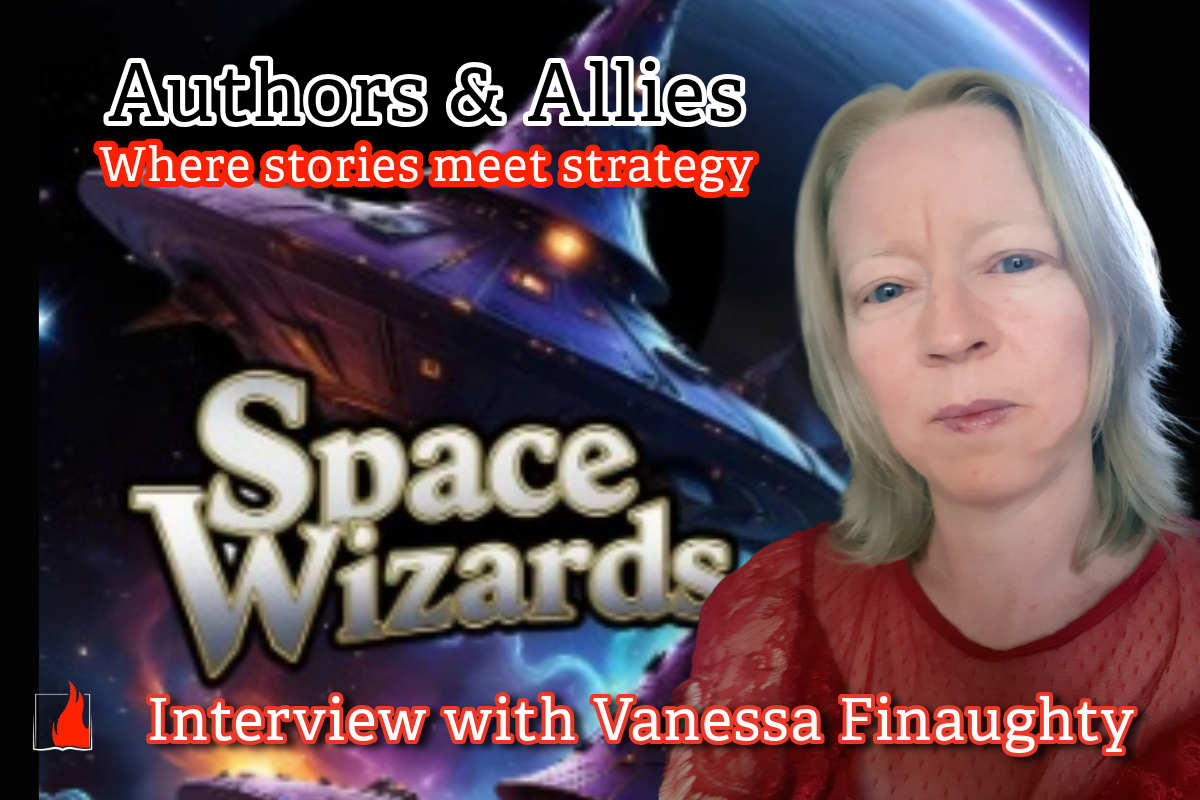
Vanessa Finaughty returns to Authors and Allies to discuss her ambitious new anthology project and the grittier corners of her extensive backlist. Following our deep dive into the Wizard of Ends series last October, we now turn our gaze to the stars—and the shadows.
In this follow-up, we explore the clash of magic and technology in her upcoming Space Wizards anthology, the psychology behind mixing horror with erotica, and the shifting landscape of indie publishing in 2026.
Technomancy and Space Wizards
Willy: You’ve recently put out a call for a Space Wizards anthology, specifically looking for stories that blend Science Fiction and Fantasy. This is a sub-genre that often gets overlooked or lumped into Science Fantasy. What is it about the clash of technology and magic that appeals to you as an editor? Are you looking for technology that feels like magic, or literal wizards on spaceships?
Vanessa: I haven’t seen a lot of proper sci-fi fantasy out there, so it seemed a good option—there are other people out there like me who really enjoy this type of thing and are not properly catered to (yet). The Space Wizards theme can be interpreted in many ways, and I’ve left it open for each author to interpret it how they will—the only musts are that both outer space and wizards must be involved, with elements of both fantasy and science fiction.
To give you a better idea, of the stories already submitted, some are ‘wizards on a space ship’, some are ‘wizards on a space station or space city’, some are ‘alien wizards on Earth’, and some focus more on the science fiction/technology aspect, while some include magic-fused machines—I must say, I’m enjoying reading the submissions! I’m keen to see any other interpretations of the theme as well—the idea is to make it a really fun anthology where readers won’t know what to expect from each story and can be surprised (in a good way) each time. Either ‘technology that feels like magic’ or ‘literal wizards on spaceships’ would be a good fit for the Space Wizards anthology, as well as any other interpretation of the theme.

Willy: In our last interview, we spoke about your life as an author. Now you are stepping into the role of editor/curator for this anthology. What is the number one mistake you see authors make when submitting to a specific theme like this? Is it ignoring the prompt, or trying to shoehorn an old story into a new box?
Vanessa: The number one mistake was not including one of the important theme elements: a wizard, and outer space.
Willy: The prompt specifically asks for a wizard as the main character. In modern spec-fic, the Gandalf archetype has been deconstructed a thousand times. What kind of Wizard are you hoping to see in these submissions? Are you looking for the classic robe-and-staff vibe, or something entirely reinvented for the vacuum of space?
Vanessa: A bit of both! I love both and am happy to say we have a nice mix so far! We have alien wizards, a time-travelling biker wizard, a scientist using magic, a child wizard with a pocket griffon familiar, and Merlin himself (among others). Add a space battle, cyborgs, robot cat familiar, quantum conjurings and technology parading as magic—and I’m still taking submissions until the end of February 😉

Origins, Horror, and the Visceral
Willy: While Wizard of Ends is high fantasy, your Legends of Origin series (starting with Sanctuary for the Devil) dives deep into ancient alien theories and the origins of humanity. How did you approach rewriting the ultimate villain—the Devil—as a sympathetic or misunderstood figure in this sci-fi context?
Vanessa: That entire series exists because of a scene that popped into my head: a man running across a beach covered in glass, pursued, trying to reach safety. I started to write that scene and the rest just popped into my head as I wrote. I didn’t plan any part of that series—it’s loads of fun to write that way! Part of what popped into my head was how horrible must it feel to have amnesia and then find out you’re actually the worst person ever, and I wrote based on how I imagined that might feel.

Willy: You have a title in your backlist called Horrotica. Horror and Erotica are both genres that rely heavily on visceral physical reaction—fear and arousal. Do you find that the writing muscle used to scare a reader is similar to the one used to seduce them? How do you balance those two extremes without one overpowering the other?
Vanessa: I think the two genres mixed makes it a lot easier to invoke those feelings in readers—it’s known that fear has the potential to heighten arousal when there is no real danger. I chose some of my plots like usual, with a horror theme, and then worked in the erotica to make it even more horrifying, and other plots were plotted more with erotica in mind and the thought ‘how to make this situation scary’. It was surprisingly easy once I got started—I’m not sure I want to know what that says about my mind :p
Willy: You are a prolific short story writer (Dragon Kin, Terrorscape). Many indie authors struggle to sell short fiction collections. Do you view your short story collections as products to generate income, or do they serve a different strategic purpose in your catalogue, like keeping readers engaged between major novel releases?
Vanessa: A bit of both. I enjoy writing short stories in between full-length novels. It’s kind of like a holiday for my muse, where she gets to ‘write whatever as long as it’s good’ instead of remembering what a character did three books ago (I have a file for each book to keep track of the finer details). It’s also good to remind readers that you’re still around and still writing—fans move on if you don’t publish something new for too long.
I must say, the collections haven’t sold as well as my novels—I did some research and it seems they were originally half the length that readers expect from that type of book, so that might have been the reason. I thus wrote more stories to add to each collection, and have now published second editions of all but one (which I’m busy with at the moment). So far, though, doubling the lengths doesn’t seem to have added more than a handful of extra sales. Still, I’ll keep writing more, because they serve their purpose and are super-fun to write.
Unearth More Bookish Treasures


Navigating the Indie Landscape
Willy: You publish everything from educational school books to Horrotica to High Fantasy. Strategically, how do you manage your brand so that a parent looking for your educational material doesn’t accidentally stumble into your horror-erotica? Do you segment your mailing lists, or do you trust your readers to read the blurb?
Vanessa: You won’t believe this, but… I have no mailing list! I know, I know… I’ve never been good at enticing people onto lists looks at the ceiling. If I did have a mailing list, I would probably separate it by genre. The school books aren’t part of my indie author profile, so those should never appear anywhere on any author page together with stuff like erotica. Those are normally advertised by the schools publisher and are commissioned works, while most of my other work is indie published and might appear together.

As far as differentiating between genres so that a horror fan, for example, doesn’t accidentally click on another genre that they might find boring, I try to make the genre super-clear on the cover. We’re supposed to do this anyway, even if we only publish one genre—a cover should immediately tell the reader what to expect inside the book, and then the title, and then the back cover blurb. For example, my erotic horror has a sexy woman, a topless man and monsters on the cover, my horror has a giant praying mantis on a gravestone holding a monster head, my free short story about vampires has vampire teeth on the cover, my dragon anthology has a dragon and so on. There are some of my covers that don’t quite achieve this, but those are older covers and I have plans to redo some of them.

Willy: Since we last spoke, you’ve continued to be incredibly active with tours and calls for submissions. As we move deeper into 2026, what is the biggest change you are seeing in the indie author community? Is it harder to get visibility now than it was when you launched Wizard of Ends?
Vanessa: The biggest change I’ve seen is the increased use of AI. You get some, like me, who use AI for book covers and promo materials—I’m not an artist and can’t afford to pay one, so AI is a huge help to me in creating the packaging (cover) for my books, as well as for creating things like book trailers. Then you get others who think it’s a cool idea to use AI to write a book. Others find AI useful for helping with blurbs and ad writing, or helping with plot ideas, etc.
As for visibility, I think it’s definitely harder. Indie publishing is now much more accessible to authors, which means there is a huge number of new books published every year. When I first started publishing, indie authors were also spoilt for choice when it came to where to share our books, and I never struggled to find decent free promo offers. Now, it takes many long hours of searching to find half-decent promo opportunities, and then most of them are paid services.

Pop Culture and Survival
Willy: Since Space Wizards is on the brain: If you had to be trapped on a long-haul space freighter with one wizard from pop culture (Gandalf, Harry Dresden, Doctor Strange, etc.), who would you pick to help you survive the trip?
Vanessa: I think definitely Merlin—as portrayed in the 2008 TV series, The Adventures of Merlin. He’s a real fun character!
Thank you for visiting with us. For more Reviews or Literature related content, visit our blog at The Ritual. Copyright Mind on Fire Books.

A Dark Fiction Collection of Folklore and Body Horror
Folklore and Flesh is a masterwork of dread operating at the convergence of two primal anxieties: the terror of the isolated environment and the fear of the body betraying itself. In exploring these tensions, we must consider what makes us human or drone. This is Folk Body Horror: a fusion of ancient cultural dread and grotesque physical transformation.
In this collection of dark stories and poetry, the boundary between myth and matter collapses. The tales explore the uncanny territory where ancestral lore ceases to be a cautionary story and becomes a biological instruction manual for corruption.
This collection binds 10 creative short stories and a dozen visceral poems.


Leave a Reply