

In this interview, we discuss his new space opera A Question of Evil, the influence of his BIPOC identity on his characters, and how he manages a creative life in a bustling three-generation household on a remote archipelago.
From Jersey to the Faroes
Willy: You have one of the most unique author origin stories we’ve heard—moving from the U.S. East Coast to the Faroe Islands. How has living in such a dramatic, remote, and atmospheric landscape influenced your world-building? Do you find the isolation of the islands seeping into the Sci-Fi Noir or Horror elements of your work?
Sam: I was born in NY, raised in NJ and spent the bulk of my years there, but what drew me away wasn’t my writing, it was love. I met a Dane online while gaming, and we began to chat. She was fun and was into a lot of the same things I was. Before long she even asked to see some of my writing. Over the months something grew that neither of us expected. Next thing you know we’re married and the planning began for me to move out here.
At first, I would say the remote location didn’t alter my writing at all. However, it has begun to seep into my short stories and even novels. Last year I wrote two horror short stories taking place in the Faroe Islands, and now the Faroes has seeped its way into the sci-fi novel I’m currently writing. I’m adopted (my biological parents were Puerto Rican and Polish Jew), and I was adopted into a Jewish family, and that has impacted my writing more than once as well (but not as much).
Willy: You identify as BIPOC and write across the Speculative Trinity (Sci-Fi, Fantasy, and Horror). In your new novel A Question of Evil, you deal with empire and rebellion. How does your personal identity and your experience as an expat shape the way you write themes of belonging or otherness in characters like Angel?
Sam: Despite taking place in the 24th century, I think some constants always remain and that can change how I write (and how characters are regarded). Angel is of Hispanic (Puerto Rican) background, same as me. Also, I wrote a horror short story “The Third Rule”, where the protagonist was a Puerto Rican girl from New Jersey in a Massachusetts university, and a historical fantasy short story that takes place on the island when the Taíno still lived there. Both of those stories appeared in different anthologies last year.

Empire, Evil, and Superheroes
Willy: Your new book launches The Imperial Chronicles with a high-stakes dynamic: a street rat (Angel) versus a rising Overlord (Tanus). Reviewers have praised the morally grey tone of the book. In a genre that often defaults to clear-cut heroes and villains, how do you approach writing an antagonist like Tanis to ensure he feels complex rather than just a caricature of evil?
Sam: I’ve often wondered if the typical “bad guy” you see in books and movies think they are bad. Are they truly evil? Or has circumstance molded them? This is the underlying theme of A Question of Evil while on the surface it’s a fun space opera adventure/romance. When I first wrote in Tanus Adalric, he was too driven (he needs to be driven, but the motivations are just as important, or you’ll never care what happens to him). I dialed him back and gave him a history that I hoped would resonate with the readers. Yes, as the story opens up, he’s just a heartbeat from the Imperial throne, but it isn’t until later the readers get to see what led him there (in fact, in the Prequel novel that will come out in October, you’ll get even more background info on him).
As for Angel (though she’s only “Angel for the first two chapters”) you have a real victim of circumstance. The story opens with her in prison for killing the pirate leader she was following, even though she did it to save the life of the Alliance naval captain who was rescuing them. She escapes and goes from one scrape to another until the two stories finally merge and she finds herself making choices she never imagined. Choices that towards the end really make her wonder what good and evil are.
Willy: You’re also a contributor to the Where Legends Walk superhero anthology. Writing superheroes is very different from writing deep-space Sci-Fi or Horror. Did you find it difficult to switch gears into the superhero mode, and did you take a classic approach or a more deconstructionist (e.g., The Boys) angle for your story?
Sam: Last year I challenged myself to write some stories in genres I’d never tried before. I wrote three “Weird/Horror Western” short stories and the one “Superhero” story. It was not an easy switch, but I’ve always loved superheroes (though I’ve never seen The Boys). I was dealing with a more classic approach, using DC and Marvel as my base. I also had a number of years playing Champions (superhero table top roleplaying game), so creating superheroes was something I was familiar with. I was thrilled when “Five Gold Rings” was accepted into that anthology (no luck yet with the weird westerns).
Unearth More Bookish Treasures


Process and Building a Platform
Willy: Before releasing your novel, you built a resume with short fiction in magazines and anthologies like Mobius Blvd. For indie authors trying to build a platform, do you recommend this short-game strategy? How has getting those smaller credits helped you when it came time to market a full-length novel?
Sam: I think being able to create a resume of published short stories (or contest wins) gives your query letter a little more meat. Though I’ve also submitted to some places that don’t want to see your publishing credits, or will limit them to your “top three”. Obviously, I do not list all the things I’ve had published in my queries, but I do update them with what I consider the bigger ‘wins’ that I feel a publisher may find noteworthy. This way my query letters stay fresher.
Willy: You have a full house—a wife, kids, three grandkids, and three dogs! A common struggle for our readers is finding time to write. What is your specific strategy for getting words on the page amidst a busy family life? Do you have a strict ritual, or do you write in the margins of the day?
Sam: Yes, this is a challenge. The main reason I moved to the Faroe Islands (instead of my wife moving to the States) was her family. When I married her, she was already living in a three generation house (her parents and her son and his wife). They all accepted me in with open arms, and though we lost her father not long after I arrived and her mother was hospitalized, it stayed a three generation house as grandchildren started to arrive (I adore them all), plus three dogs!

Sam’s contemporary sci-fi story “In the Eye of the Beholder” won 1st Place. You can read about it here https://kinsmanquarterly.org/so/2dPa1rgRp.
I try to write during the day when I can, but we help out a lot with babysitting, and since we all live under the same roof, the grandkids love to come and visit. In the end, my prime writing time is after the grandkids are asleep and the house quiets down. So, no strict ritual, but I try to use the time I can, when I can. Before I moved here, I was an IT Tech (mostly Help Desk) for over three decades, so I’m used to “interrupt driven” work, and that’s helped me as a writer to be able to stop on a dime for a family interruption and then pick up again when I can.
Willy: You joined the Horror Writers Association (HWA) in 2024. For authors who are introverted or geographically isolated (like you in the Faroes!), how important has joining a formal organization been for your professional growth and networking?
Sam: I joined the HWA in 2024 hoping for more contacts, but at first, I didn’t find much there. I created my author page on Facebook and joined many other author groups, so I have a lot of contact with some very nice authors there. As for the HWA, there is no local chapter in the Faroes, but I recently discovered that the Faroes were close enough to England to join their chapter, which I did. So, I have a good hope that things will pick up there (I’m already seeing more communicatons). I also joined SubStack and started building a following there (in fact that’s where I moved my blog to).
Creative Fuel & Island Life
Willy: Since we ask everyone about their creative fuel: Living in the Faroe Islands, is there a specific local food, tradition, or view that serves as your reset button when you are stuck on a plot hole?
Sam: I wish I could tell you that there was some fantastic organic, good for you snack I would fall back on, but there isn’t. There is a lot of salmon here, and I grew up in a Jewish household so eating bagels and lox was something I always loved. I also have Celiac disease (no gluten) so many foods are restricted for me. Here in the Faroe Islands, they love their fish, sausages and lamb. But for me, my creative food is gummy bears and chocolate covered raisins (I may be sixty, but I think my creative side is a lot younger than that).

Thank you for visiting with us. For more Interviews or Literature related content, visit our blog at The Ritual. Copyright Mind on Fire Books.

A Dark Fiction Collection of Folklore and Body Horror
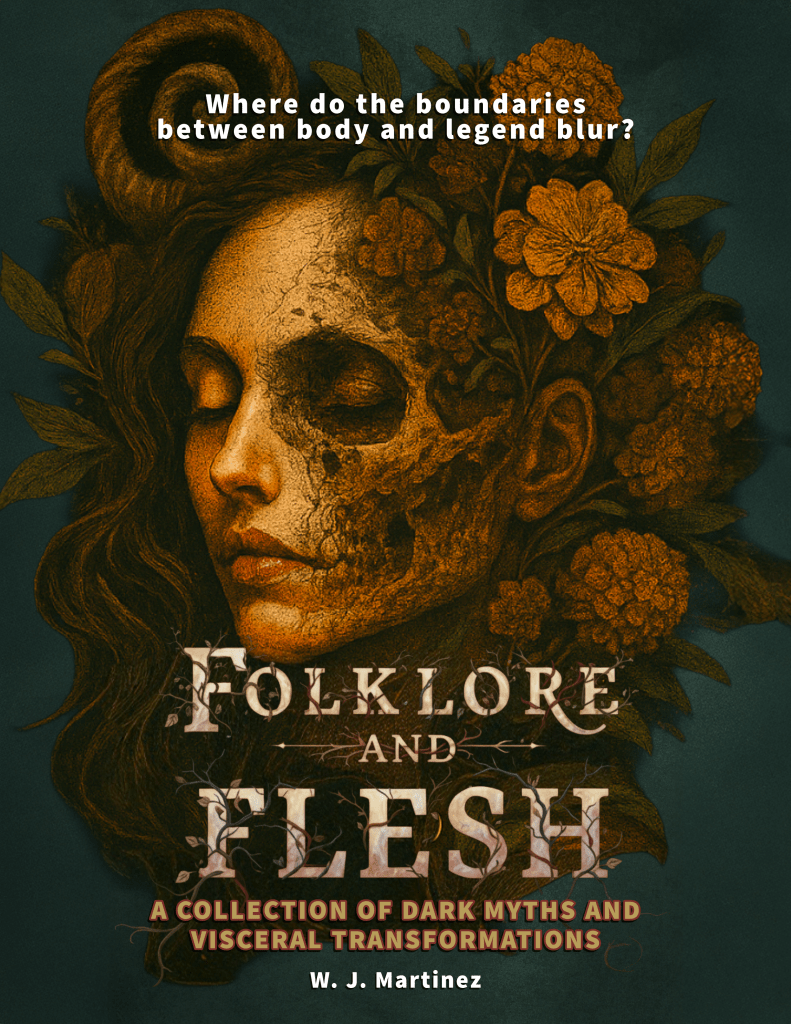
Folklore and Flesh is a masterwork of dread operating at the convergence of two primal anxieties: the terror of the isolated environment and the fear of the body betraying itself. In exploring these tensions, we must consider what makes us human or drone. This is Folk Body Horror: a fusion of ancient cultural dread and grotesque physical transformation.
In this collection of dark stories and poetry, the boundary between myth and matter collapses. The tales explore the uncanny territory where ancestral lore ceases to be a cautionary story and becomes a biological instruction manual for corruption.
This collection binds 10 creative short stories and a dozen visceral poems.




Leave a Reply