

It is 5:00 AM. A Tuesday. The hour when the veil is thinnest and the world’s quietest lies start to sound like shouting. As an author of dark fiction and a student of rhetoric, I don’t just live in this hour; I harvest it.
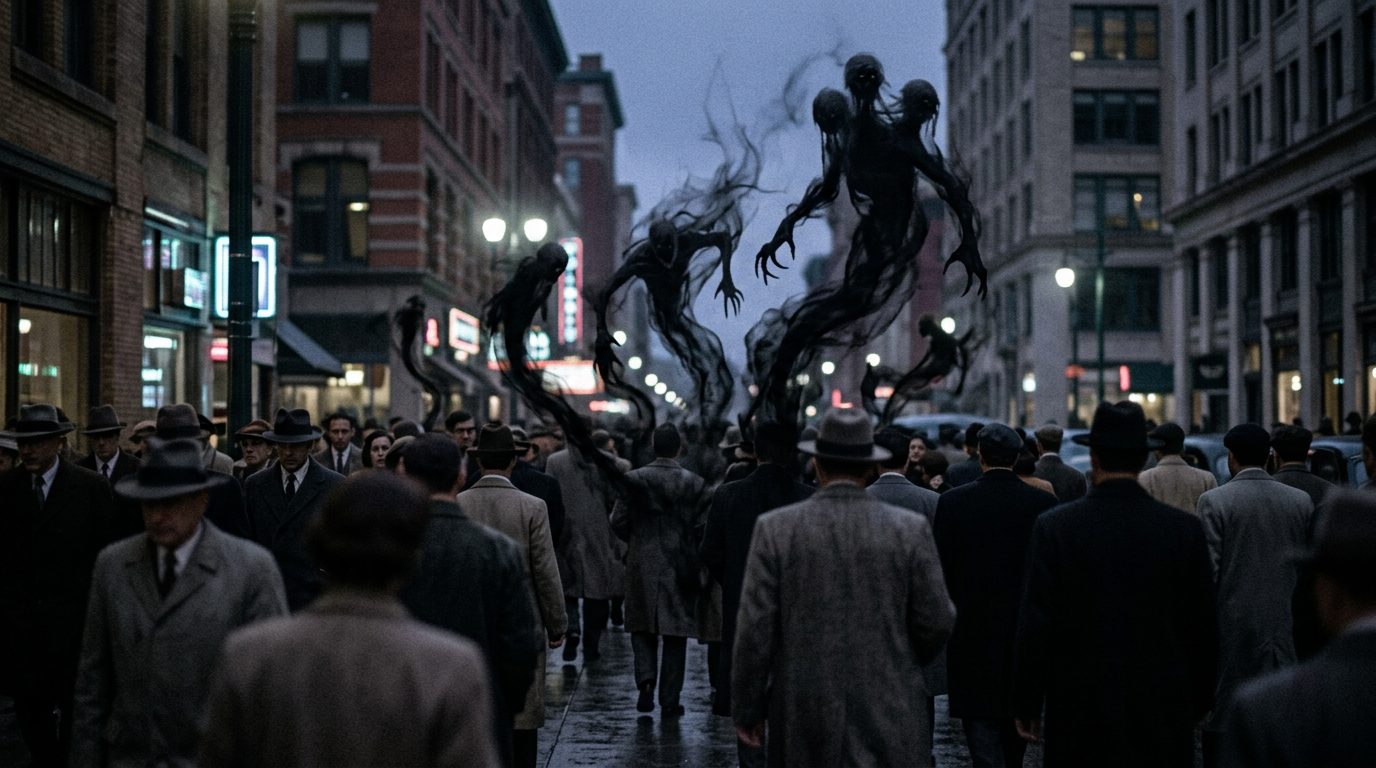
We often think of fear as a wild, uncontrollable beast. But the truth is much more clinical: Fear is a crafted narrative. It is a tool of persuasion used to direct your attention away from the crumbling foundation and toward the flickering shadow on the wall.

The Displacement of Dread
In my work, I study how certain “monsters” are promoted while others are hidden. Sociologist Barry Glassner, in his foundational work The Culture of Fear, calls this “displacement.”
The rhetoric of our current age focuses on the spectacular: the sudden cyber-attack, the viral outbreak, the dramatic market crash. These are the “jump scares” of reality. But while we are gripped by these high-octane fears, the structural monsters—the slow decay of our infrastructure, the erosion of nuance in discourse, and the fragility of our “just-in-time” supply chains—continue to feast in silence.
The Gothic Decay of Complexity
When I build a dark fantasy world, I often look to Joseph Tainter’s The Collapse of Complex Societies for inspiration. Tainter’s thesis is that societies collapse not from a single blow, but because they become too complex to maintain.
We are living in a Gothic ruin of our own making. Our systems have become so intricate that even the experts don’t fully understand how they hold together. The “rhetoric of fear” serves as the wallpaper covering the cracks. We are told to fear the disruption of the system, rather than the nature of the system itself.
“The most terrifying thing about the abyss isn’t that you might fall into it, but that you’ve been living on its edge so long you’ve started to call it a view.”

Reclaiming the Script
To survive a dark story, the protagonist must stop reacting to the monster and start understanding the plot. If you feel that 5:00 AM prickle of anxiety, don’t try to numb it. Use it as a diagnostic tool.
- Deconstruct the Headline: When you are told to be afraid, ask: Who benefits from my paralysis? Is this a spectacular fear designed to hide a systemic one?
- Audit the Foundation: Stop looking at the shadows. Look at the floor. Where are you dependent on a system you don’t control? Resilience is the only antidote to rhetorical manipulation.
- Find the Liminal Space: The 5:00 AM hour is yours. It is the time to write your own narrative before the world’s rhetoric tries to write it for you. [Link: Explore my library of “Survival Rhetoric” here].
The sun is rising, and the world is about to get loud. But remember: the loudest voice in the room is rarely the most honest one. The monsters aren’t in the spectacular future; they are in the silence of the systems we take for granted.
Stay awake. Stay sharp. And whatever you do, don’t stop writing.
Join the Conversation: What is one thing you were taught to fear that you now realize was just a distraction?
Thank you for visiting with me. For more Poetry or Literature related content, visit my blog at The Ritual.




Leave a Reply