
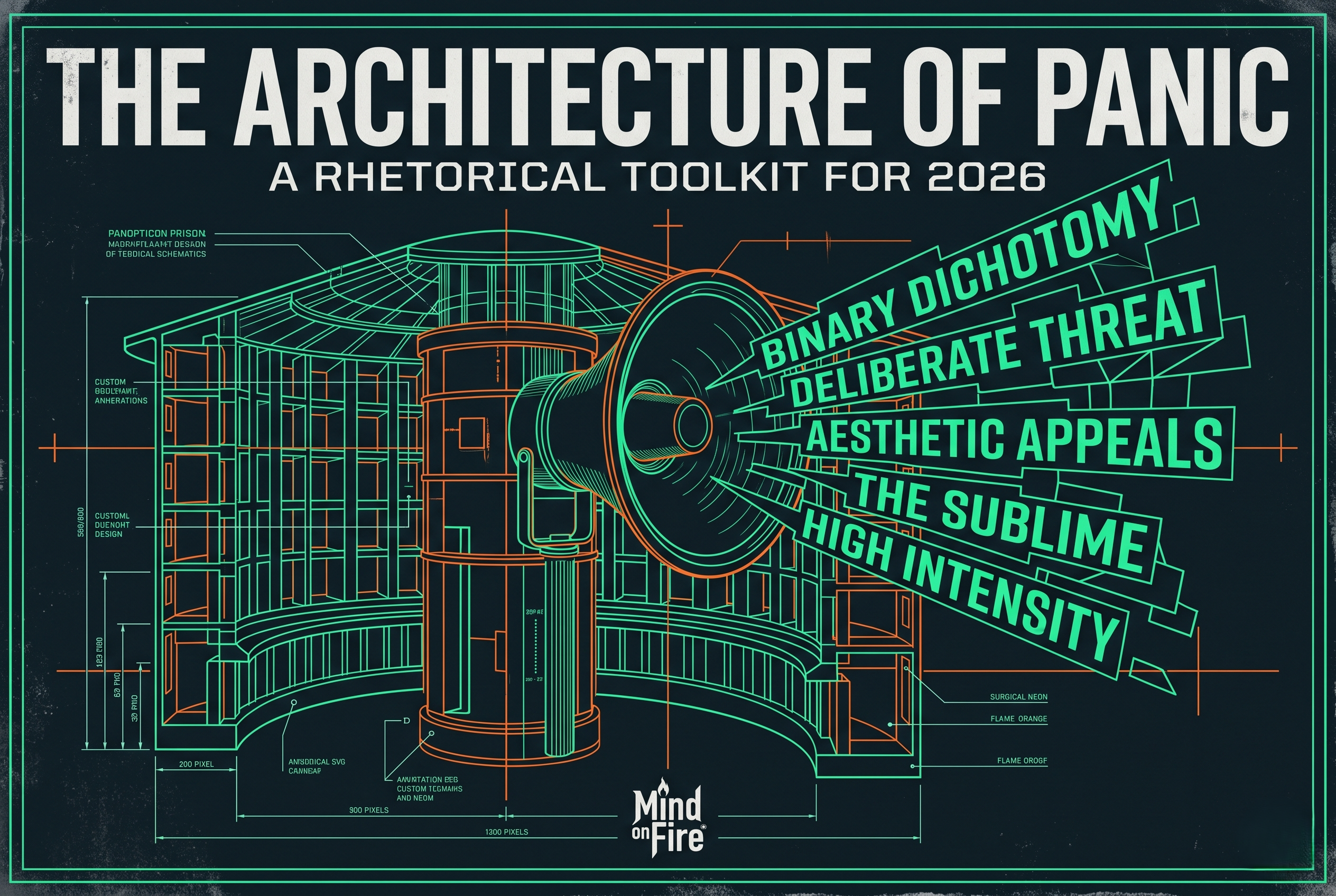
I was rereading Orwell’s 1984 recently—not for the plot, but for the vibe. There is a specific frequency to the Two Minutes Hate that feels uncomfortably familiar when scrolling through your 2026 newsfeed. It’s not just noise; it’s a meticulously designed signal of panic. Sometimes, the effect can only be described as Panic in motion.
Welcome to the age of Fear Speech, where Panic becomes a tool of rhetoric.
In academic circles, we’ve begun identifying “Fear Speech” as the sophisticated, suit-and-tie cousin of hate speech. While hate speech is often crude and easily moderated, fear speech performs a more delicate surgery on the public psyche: it masks itself as “civic concern” while forcing the mind into a state of Binary Fear. Panic is often used as a mechanism to manipulate this emotional state.
If you are a fan of Heinlein’s “competent man” or Orwell’s doomed protagonist, you know that the first step to sovereignty is seeing through the static. You don’t need a bunker; you need a toolkit. Above all, learning to identify Panic in public discourse is essential.
The 4-Point Fear-Appeal Audit
To remain a citizen rather than a subject, you must relentlessly interrogate the rhetoric being fed to you. When a leader or institution speaks, run their words through these four heuristics:
1. The Binary Dichotomy (“Us vs. Them”)
Look for the collapse of complexity. Fear speech thrives on a singular choice: acquiescence to the state or total extinction. It creates an “In-Group” of the protected and an “Out-Group” of the monstrous other. If there are only two options on the table, someone is hiding the rest of the room.
2. Establishing a Deliberate Threat
A fear appeal requires a specific, looming catastrophe—often biological or existential—to justify the suspension of normal deliberation. Is the threat presented as a problem to be solved, or a monster to be feared?
3. Aesthetic Appeals (The Sublime)
This is where rhetoric becomes art. As Edmund Burke observed, the Sublime (terror mixed with awe) is the strongest human emotion because it robs the mind of its ability to reason. Modern fear speech utilizes grand, obscure, and terrifying language to transport the audience to a “commonplace” where public opinion is molded by gut instinct rather than logic.
4. High Intensity
Pacing is everything. By creating an artificial sense of urgency, institutions bypass democratic deliberation. If you are told you must act now or lose everything, you are being manipulated into Binary Fear, which limits choices and forces submission.

Based on your taste in literature, I think we could be good friends. Sign up below for the archive below and free eBook giveaways.
Civic Fear vs. Binary Fear
It is crucial to differentiate between the two. Civic Fear is healthy; it identifies a problem and opens up public deliberation to find a solution. It respects your agency.
Binary Fear, however, is a cage. It utilizes the Clinical Gaze to turn your biological anxieties into data points for management. It doesn’t want your opinion; it wants your acquiescence.
“The soul is the effect and instrument of a political anatomy; the soul is the prison of the body.” — Michel Foucault
Don’t Be a Character. Be the Author.
In a world addicted to the “Sublime Uncertainty” of the news cycle, the most radical act you can perform is a slow, methodical audit of the things that terrify you. Stop being a character in a dystopian novel written by a committee.
Sources & Receipts
- Agamben, G. (1995). Homo Sacer: Sovereign Power and Bare Life.
- Burke, E. (1757). A Philosophical Enquiry into the Origin of Our Ideas of the Sublime and Beautiful.
- Foucault, M. (1975). Discipline and Punish: The Birth of the Prison.
- Orwell, G. (1949). 1984.
- Wagner, C., & Morisi, D. (2026). “Theoretical Foundations for Fear Speech.” ACL Anthology.
Please visit our blog at The Ritual for related research on the Rhetoric of Fear.


Leave a Reply