

Have you ever stared at a popcorn ceiling until it began to snarl? Or perhaps you’ve noticed how a knot in a piece of driftwood looks suspiciously like a weeping grandmother?
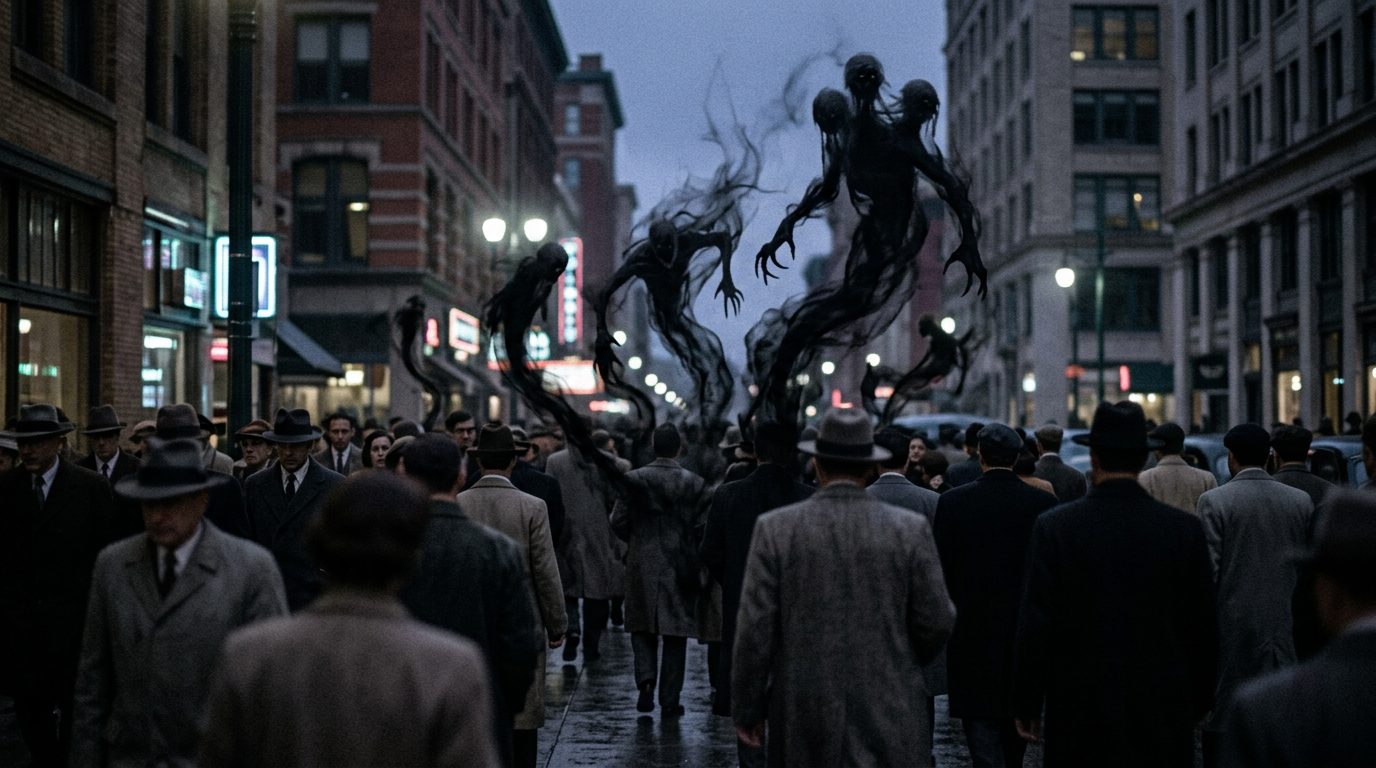
That’s pareidolia—the human brain’s desperate, hard-wired tendency to impose meaningful patterns (usually faces or figures) on random stimuli. Evolutionarily, it’s a survival hack. It is far better to mistake a rustling bush for a tiger ten times than to mistake a tiger for a rustling bush once. But in the hands of the rhetorician, the politician, or the cosmic horror writer, pareidolia isn’t just a psychological quirk. Rather, it is a weaponized cognitive glitch used to manufacture monsters and justify the mechanics of power.
I. The Architecture of the Binary Fear
In rhetoric, specifically within the fear appeal, we look for a deliberate dichotomy. Power doesn’t just want you to be afraid; it wants you to see a face in the fog and name it “Enemy.”
When a government describes a vague, sprawling geopolitical shift as an “Axis of Evil” or a “Shadowy Cabal,” they are engaging in a form of societal pareidolia. They take the chaotic, entropic noise of global economics and human migration—which is inherently meaningless and terrifyingly complex—and they force a face onto it.
- The Heuristic of the Threat: By giving the “void” a face, the institution transforms a “civic fear” (which invites us to deliberate and solve) into a “binary fear” that forces acquiescence.
- The Result: You stop thinking and start reacting. Once the face is “seen,” it cannot be unseen.

II. Lovecraft and the Objective Rationalism of the Pattern
H.P. Lovecraft understood that the most terrifying thing isn’t the monster you see, but the pattern you think you’ve discovered. This is where we pivot from the religious “demon” to objective rationalism.
In the Victorian ghost story, a haunting was often moral—a debt unpaid. But in modern horror, pareidolia is framed through the scientific lens. In The Call of Cthulhu, the horror arises from the protagonist connecting disparate data points—archaeological finds, newspaper clippings, and psychiatric reports. He is effectively performing an academic pareidolia.
“The most merciful thing in the world, I think, is the inability of the human mind to correlate all its contents.” — H.P. Lovecraft
The “monster” here is actually the Sublime. According to Edmund Burke, the sublime is found in the “obscure.” When the pattern is incomplete, the mind fills in the gaps with its greatest anxieties. The state uses this “duration of uncertainty” (as Tzvetan Todorov might call the hesitation between the uncanny and the marvelous) to keep the populace in a state of high-intensity suspension. If the threat is “everywhere” but “unseen,” the power to “see” it becomes the ultimate authority.

III. Foucault and the Panoptic Pattern
Michel Foucault’s work on the Panopticon is essentially pareidolia as a form of social control. In a circular prison where the guard tower is obscured, the prisoner imagines the face of the guard.
- The Discursive Network: The prisoner imposes a pattern of “surveillance” onto the empty windows of the tower.
- Self-Governance: The fear of the “perceived pattern” (The Watcher) causes the subject to internalize the power of the state—a classic example of parrhesia being stifled before it can even begin.
We do this today with data and algorithms. We see “the algorithm” as a sentient, perhaps even malicious, entity that “knows” us. In reality, it is a series of cold, mathematical weights. We are staring at a digital Rorschach test and seeing our own desires and fears reflected back. Then, we blame the “monster” in the machine for our loss of agency.
The Controversial Take: The Monster is the Map
We must realize that our “monsters”—whether they are the “savage” in war rhetoric or the “specter” of economic collapse—are often just projections of the internal architecture of our laws. We create the monster so we don’t have to face the void. In fact, we prefer a Cthulhu or a “Great Replacement” theory because a face, even a terrifying one, implies a motive. And a motive can be fought.
What we truly fear is the Asemantic Void: the possibility that there is no face in the clouds, no hand on the tiller, and that our power structures are just children whistling in a very loud, very dark, and very indifferent graveyard.
Next time you see a face in the shadows, ask yourself: Did the shadow put it there, or did your need for a villain create it? In the theater of power, the one who draws the face on the wall is the one who owns the room.
Thank you for visiting with me. For more Poetry or Literature related content, visit my blog at The Ritual.




Leave a Reply