
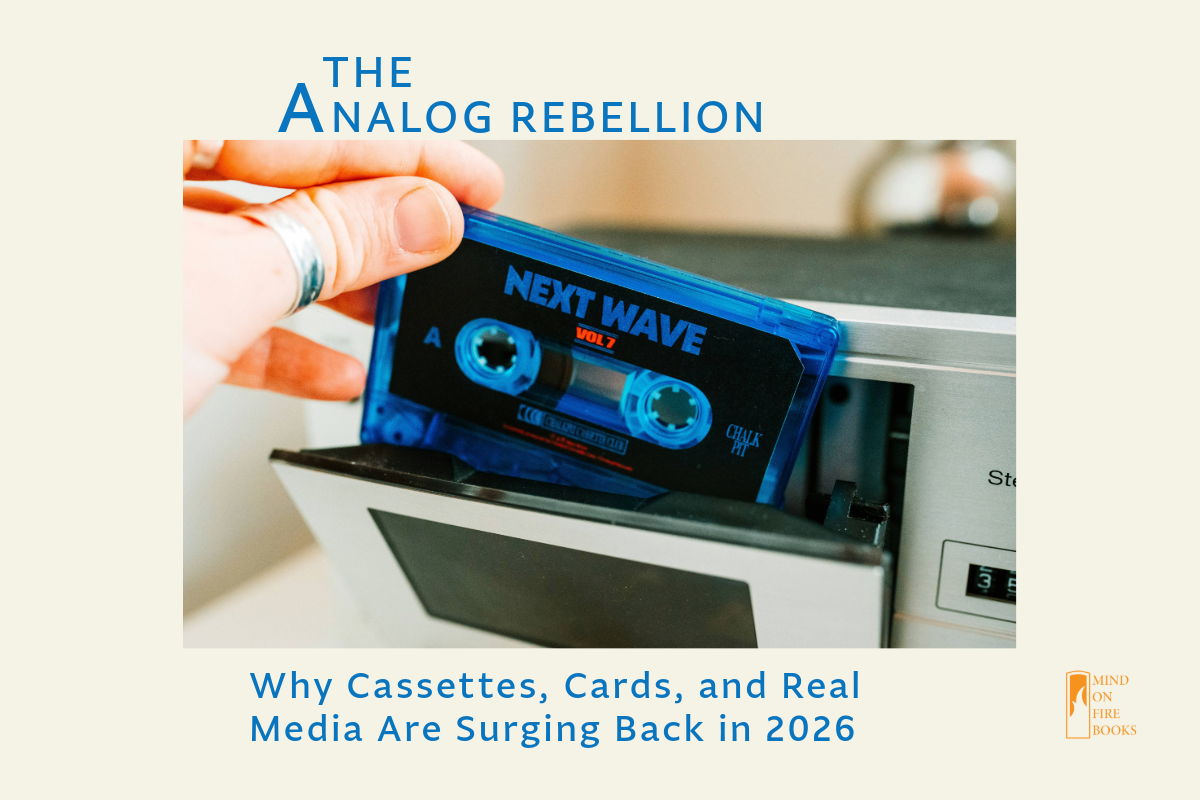
I brought sushi and Capri Suns and left with a cassette lesson.
I was at a friend’s house for dinner: turkey meatloaf, sushi (yes, both), Capri Suns as the peace offering, and a new card game—Five Crowns—that I learned between bites. While my daughter and the other kids toggled between a console and phone feeds, I sat at the table playing cards and talking shop with my friend. Then his oldest son produced a cassette player: not a museum piece, but a hybrid model that senses tape jams, shuts off, and even has an SD slot and USB charging. I joked about making mix SD cards like the mixtapes we used to trade; he looked at me like I’d described something extraordinary. That moment felt like a small, private rebellion against the stream.
Original Photo for Cover Image by Silas Gregory on Unsplash.

Why that cassette matters (and why you should care)
The analog comeback isn’t just retro chic. It’s a behavioral counterweight to an attention economy designed to fragment us. People are choosing ritual over frictionless convenience: the act of placing a tape, dropping a needle, or shuffling a deck forces a different tempo of attention. Cal Newport’s Digital Minimalism frames this as intentional technology use — keep the tools that serve your values and remove the rest.
Vinyl sales, for example, have surged in recent years and now represent a meaningful slice of music revenue; the format’s tactile appeal and ritualized listening are major drivers of that growth. Cassettes are smaller in scale but follow the same logic: low‑cost, collectible, and deliberately sequential listening that resists algorithmic shuffle.
The science behind slowing down: presence, attention, and nature
Choosing analog media often pairs with other low‑tech practices that restore attention. And if you’ve read some of my other posts, you would know I’m big on hiking the Shawnee forests. Research on shinrin‑yoku (forest bathing) and nature therapy shows measurable short‑term reductions in anxiety and physiological stress markers, supporting the idea that slower, sensory‑rich experiences change our nervous systems.
Put simply: rituals that require touch and time (a tape, a record, a walk in the woods) create effortful attention rather than passive consumption. That effort is the point — it’s how we get depth instead of distraction.
What the kid with the cassette taught me about generations and markets
Seeing a kid with a cassette player that also reads SD cards was instructive. Younger people aren’t necessarily romanticizing the past; they’re experimenting with materiality and ways to resist fully algorithmic culture. Physical media also has practical economies: kids flip Mad magazines and Pokémon cards into eBay side hustles, and artists sell limited‑run cassettes and vinyl at merch tables. The market has responded with hybrid devices that preserve ritual while adding modern conveniences.

Based on your taste in literature, I think we could be good friends. Sign up below for the archive below and free eBook giveaways.
How to try the experiment (a tiny manifesto)
- Bring one analogue object — a deck of cards, a mixtape, a printed zine — to your next hangout and make it the evening’s center.
- Add friction on purpose — set phones to a basket, schedule a 30‑minute “no‑scroll” window, or play a single album start to finish.
A practical note for creators and collectors
If you’re an artist, label, or small business thinking about physical releases: vinyl remains the heavyweight in revenue and cultural cachet, but cassettes and CDs have niche advantages — lower cost, collectible appeal, and a DIY ethos that resonates with certain audiences.

Final thought
That cassette player on the living‑room table wasn’t a relic; it was a translator between generations and attention economies. It reminded me that sometimes the best way forward is to press pause — literally.
What analogue object would you bring to your next gathering to test whether attention can be reclaimed?
Please visit our blog at The Ritual for related research on the Rhetoric of Fear.


Leave a Reply