
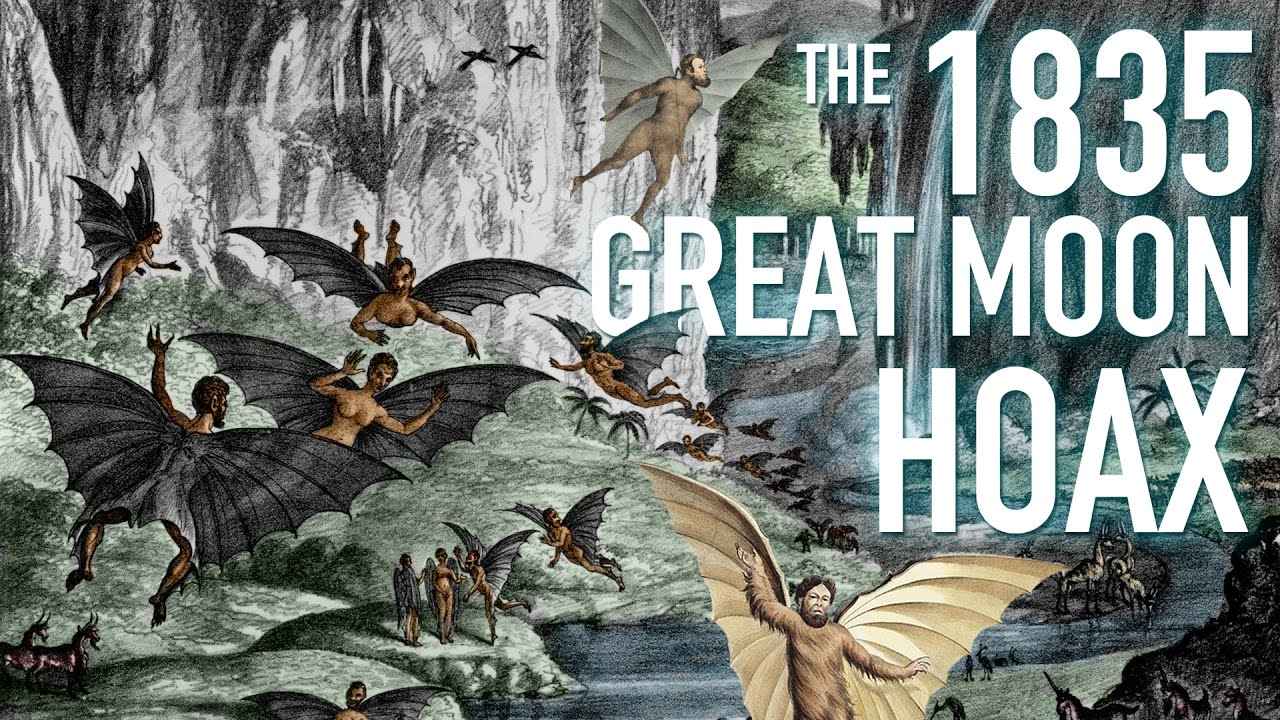
Travel back to 1835, when scientific exploration barely began and imagination thrived with captivating tales. This article explores the fascinating Great Moon Hoax, a daring journalistic fabrication that astonished readers and blurred reality’s boundaries. Get ready to be transported to a time when fact and fiction intertwined in the most delightful way.
The Great Moon Hoax of 1835
In bustling New York City, the renowned newspaper The New York Sun published an incredible revelation that captivated the masses. The publication reported exclusive findings from British astronomer Sir John Herschel, describing astonishing discoveries during his Moon observations.
The Moon Hoax, as it came to be known, unfolded in a series of articles that painted a vivid picture of a lunar landscape teeming with life. The New York Sun wove tales of moon-dwelling creatures, lush vegetation, and even humanoid bat-like beings inhabiting Earth’s celestial neighbor. The level of detail and scientific terminology used lent an air of credibility, drawing readers into a world of wonder.
As word spread, the public became increasingly enthralled by the prospect of extraterrestrial beings and a thriving lunar civilization. The articles sparked widespread discussion and debate, fueling the collective imagination and igniting a desire for further exploration of the unknown.
Week after week, readers eagerly devoured the sensational accounts, awaiting each new installment of this cosmic saga. The New York Sun’s circulation soared as people clamored to uncover each revelation, and the Moon Hoax became a cultural phenomenon.
However, as the fervor reached its peak, doubts began to emerge. Skeptics questioned the veracity of the claims, calling into question the feasibility of life on the Moon. Finally, after weeks of speculation, The New York Sun made a startling admission: the Moon Hoax was pure fiction.
This revelation shocked and disappointed many who had been swept away by the Moon’s allure. It was an unprecedented example of how a newspaper had successfully fooled the masses, blurring the line between fact and fiction in a way never seen before.
Thank you for visiting with us. For more Literature related content, visit our blog at The Ritual.
The Great Moon Hoax of 1835 showed the power of storytelling and humanity’s eagerness to believe the extraordinary. It also sparked important discussions about journalistic ethics and the press’s responsibility to verify information before presenting it as fact.
Explore the tale’s impact on Moon perception, journalism, and the enduring fascination with the unknown. Let us unravel the intricacies of this audacious hoax and examine its lasting legacy in history’s annals.
The “Great Moon Hoax” or the “Great Moon Hoax of 1835″Background
The “Great Moon Hoax” or the “Great Moon Hoax of 1835” refers to six articles published in The Sun, a New York newspaper. These articles, beginning circulation on August 25, 1835, claimed the discovery of life and civilization on the Moon. These discoveries were falsely credited to Sir John Herschel, a renowned astronomer, and his imaginary associate Andrew Grant.
The tale was initially promoted on August 21, 1835, as a forthcoming piece supposedly republished from The Edinburgh Courant. The first of six installments hit the stands on August 25. Despite never being officially retracted, The Sun confessed on September 16, 1835, that the articles were fabricated.
Thank you for visiting with us. For more Literature related content, visit our blog at The Ritual.



Leave a Reply