
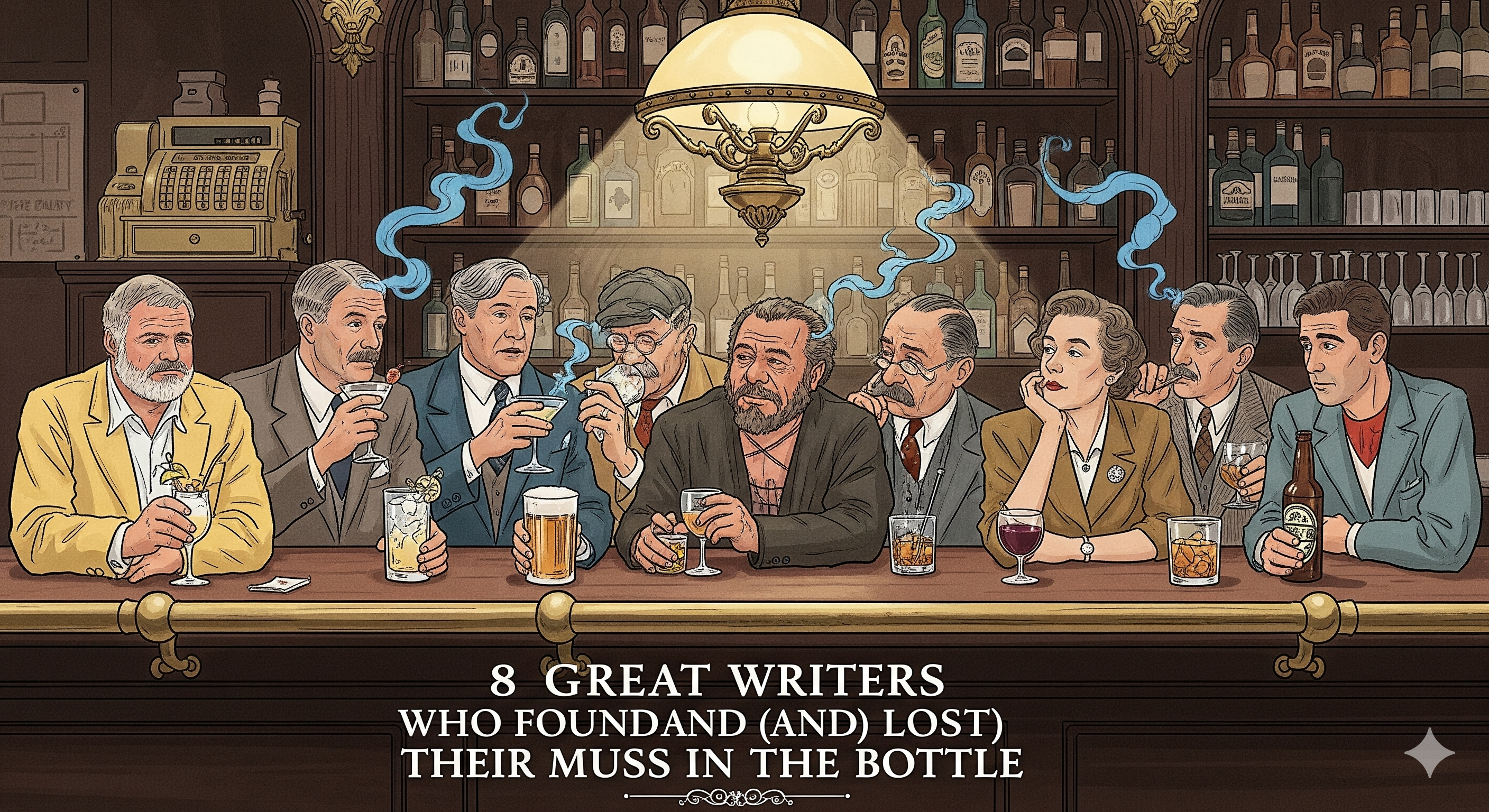
The Eternal Conundrum of the Liquid Inspiration
Among the pantheon of literary figures, there are 8 Great Writers whose work reflects a complex relationship between creativity and addiction. For as long as there have been words on a page, there’s been a romantic—and often tragic—tango between the writer and drink. From the roaring saloons of the American frontier to the smoky cafés of Paris, alcohol has been an inseparable companion for many literary giants. It’s a narrative woven into our literary history: the “drunken genius” and the “tortured artist,” those who sought transcendence at the bottom of a glass.
But what did they truly find there? Was it inspiration, a loosening of inhibitions, a brief glimpse into another realm of thought? Or was it merely a seductive illusion, a destructive habit that ultimately claimed more than it gave?
At Mind on Fire Books, we delve into the complex, often heartbreaking stories of 8 iconic writers who famously entwined their creative process with the bottle. We explore not just the legends, but the very real impact of their choices on their enduring brilliance—and their lives.
The Booze & Brilliance: 8 Great Writers Who Found (and Lost) Their Muse in the Bottle
1. Ernest Hemingway: The Code of the Cocktail
“Write drunk, edit sober.” This legendary (though likely misattributed) quote captures the essence of Ernest Hemingway’s (1899–1961) persona and process. A Nobel Prize winner and master of terse prose, Hemingway made drinking almost as famous as his writing.
The Habit
Hemingway drank heavily throughout his life, famously favoring mojitos, daiquiris, and whiskey. He believed alcohol helped him access a deeper, more honest part of his psyche. His days were often structured around writing early, then rewarding himself with copious amounts of liquor. His drinking wasn’t just recreational; it was deeply intertwined with his identity as a tough, adventurous man of letters.
The Legacy
His lean, impactful sentences often captured the raw emotion of men facing their demons, both internal and external. Yet, the price was steep. His later years were marred by increasing paranoia, depression, and ultimately, suicide, with alcohol playing a significant role in his deteriorating mental and physical health. His work, however, remains a powerful testament to his unique voice, often interpreted through the lens of his struggles.

2. F. Scott Fitzgerald: The Glamour and the Gloom
The chronicler of the Jazz Age, F. Scott Fitzgerald (1896–1940), imbued his characters with the glittering, destructive charm of the era, a lifestyle he mirrored with his own tumultuous relationship with alcohol.
The Habit
Fitzgerald’s drinking was legendary and often spiraled into public incidents. He and his wife, Zelda, were iconic figures of excess, their lives a blur of champagne, gin, and extravagant parties. He believed that drinking heightened his senses and fueled the romantic melancholy that permeates his masterpieces like The Great Gatsby.
The Legacy
His prose shimmered with lyrical beauty and profound sadness. It perfectly captures the illusions and disillusions of the American Dream. However, his addiction contributed to financial instability and strained his marriage. It also severely impacted his health, leading to his early death at 44. His tragic life echoes the grand, flawed characters he masterfully created as one of our 8 great writers.
3. Dorothy Parker: The Wit and the Whiskey for 8 Great Writers
Known for her razor-sharp wit and poignant poetry, Dorothy Parker (1893–1967) was a fixture of the Algonquin Round Table, where her brilliance was often sharpened by alcohol.
The Habit
Parker was a heavy drinker, often using alcohol as a social lubricant and a coping mechanism for depression and disillusionment. Gin was a particular favorite. Her famous bon mots and sardonic observations were often delivered with a drink in hand.
The Legacy
Her short stories, poems, and critical reviews are masterpieces of brevity and cynical insight. She captured the anxieties and hypocrisies of modern life with unmatched precision. While her wit never dulled, her personal life was fraught with struggles, and her drinking often contributed to periods of creative paralysis and personal despair. Her work remains, a testament to her unique voice, even as it reflects the shadows that often accompanied it.

4. Dylan Thomas: The Poetic Inferno
The Welsh poet Dylan Thomas (1914–1953) possessed a lyrical genius that was matched only by his gargantuan thirst for alcohol, culminating in his tragically early demise.
The Habit
Thomas was a prodigious drinker, known for epic pub crawls and legendary binges. His drinking was often a performance, a part of his charismatic, bohemian persona. He claimed to suffer from “writer’s block,” which he combated with alcohol, despite his wife, Caitlin, remarking that “he drank too much, but he did not drink to write.”
The Legacy
His poetry is alive with vibrant imagery and musicality. It remains one of the most beloved in the English language, exemplified by “Do not go gentle into that good night.” His public readings were electrifying and often fueled by drink. However, his alcoholism had a severe impact on his health. He died at the age of 39 from acute alcohol poisoning. His life serves as a stark warning about the destructive power of the bottle, even on the most incandescent talent.
5. Charles Bukowski: The Raw Authenticity
The “Laureate of Skid Row,” Charles Bukowski (1920–1994) built an entire literary persona around his raw, unapologetic embrace of drink, women, and the gritty underbelly of American life.
The Habit
Bukowski drank constantly and wrote about it relentlessly. Beer, cheap wine, and hard liquor were his muses, his companions, and the very subject matter of much of his poetry and novels. He saw alcohol as a path to truth, stripping away pretension and revealing the brutal reality of existence.
The Legacy
His work, including Post Office and Factotum, is characterized by its visceral honesty, dark humor, and unvarnished depiction of the marginalized. While he managed to maintain a long, prolific career, his alcoholism led to numerous health problems and often fueled his volatile temperament. He remains a controversial figure, but his influence on underground literature is undeniable, proving that sometimes, genius can truly thrive amidst—or despite—the chaos of addiction.

6. Jean Rhys: The Elegant Desperation
The author of Wide Sargasso Sea, Jean Rhys (1890–1979), lived a life as complex and haunting as her fiction, often battling loneliness, poverty, and a profound dependency on alcohol.
The Habit of 8 Great Writers
Rhys’s drinking was a lifelong struggle, intensified by difficult personal circumstances and a sense of alienation. She often wrote from a place of deep melancholy, and alcohol served as both a comfort and a catalyst for her introspective prose.
The Legacy
Her novels masterfully explore themes of identity, displacement, and the vulnerability of women. Her prose is exquisite and subtle, often profoundly unsettling. Despite decades of obscurity and battling alcoholism, she achieved recognition later in life. Her work captures her characters’ interior lives, mirroring her own experiences with fragility and resilience.
7. John Cheever: The Suburban Confessions of 8 Great Writers
Behind the seemingly idyllic façade of his suburban short stories, John Cheever (1912–1982) wrestled privately with severe alcoholism, depression, and a secret bisexuality.
The Habit
Cheever began drinking heavily in college and continued throughout his celebrated career. Alcohol fueled his social life and initially, he believed, loosened his creative inhibitions. He famously would wear a swimsuit under his suit and take a swim break in the middle of writing, followed by a drink. Yet, his drinking eventually spiraled into blackouts, hospitalizations, and deep personal turmoil.
The Legacy
Known as “the Chekhov of the suburbs,” Cheever’s short stories and novels, such as The Wapshot Chronicle and Falconer, offered piercing insights into the anxieties and hidden lives beneath middle-class American life. He won a Pulitzer Prize for his Collected Stories, a testament to his enduring talent. His later years saw him confront his alcoholism and ultimately achieve sobriety, offering a glimmer of hope amidst the destructive patterns of his past.
Unearth More Bookish Treasures


8. Jack Kerouac: On the Road to Oblivion
The undisputed king of the Beat Generation, Jack Kerouac (1922–1969), lived and wrote with a frenetic energy, but his relentless pursuit of experience was tragically intertwined with alcohol abuse.
The Habit
Kerouac’s “spontaneous prose” was often fueled by prodigious amounts of alcohol, particularly beer and whiskey, during his marathon writing sessions. His famous scroll for On the Road was written in a three-week, caffeinated and alcohol-fueled frenzy. His drinking was part of his counter-cultural identity, a rejection of bourgeois norms.
The Legacy of 8 Great Writers
His raw, vibrant, and experimental novels captured the restless spirit of a generation and revolutionized American literature. On the Road remains an iconic work. However, his heavy drinking escalated, contributing to his poor health and paranoia in later years. He died at 47 from an internal hemorrhage, a stark reminder of how rapidly the road to brilliance can become the road to oblivion.
The Hard Truth: A Warning, Not a Prescription
The stories of these 8 great writers offer a sobering look at the complex relationship between creativity and alcohol. While some may have felt a temporary liberation, a sharpening of wit, or a deeper emotional access through drink, the overwhelming evidence points to a tragic cost.
For every momentary flash of “liquid inspiration,” there was often a long shadow of personal struggle, fractured relationships, and ultimately, a premature end. Their brilliance shines despite—rather than because of—their addictions, serving as a powerful reminder that true genius stems from within, not from the bottle.
Thank you for visiting with us. For more Poetry or Literature related content, visit our blog at The Ritual. Copyright Mind on Fire Books.



Leave a Reply