
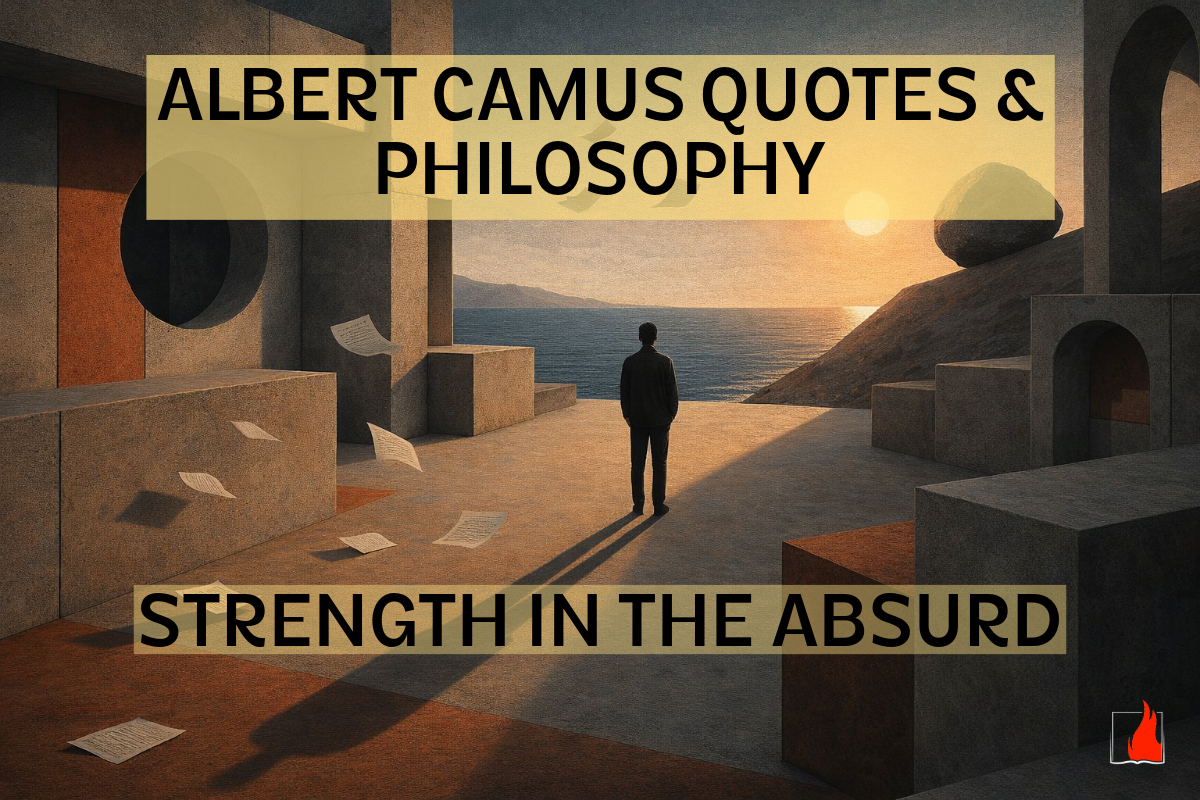
I first read The Stranger in my first year of community college. I was 19, eager, and too young to understand what Camus was really saying. Meursault’s indifference felt alien, even offensive. But now, at 42, after years of coaching, parenting, and building creative worlds, I picked it up again—and this time, it hit like a revelation. The absurd isn’t just a concept. It’s a lived experience.
Albert Camus, the French-Algerian philosopher, novelist, and Nobel laureate, didn’t just write about the absurd—he lived it. In a world that often feels chaotic, unjust, and indifferent, Camus offered not despair but defiance. His words are a balm for the disillusioned, a rallying cry for those who refuse to surrender to nihilism.

Camus and the Courage to Confront the Absurd
Camus’s absurdism isn’t about giving up—it’s about waking up. In The Myth of Sisyphus, he writes, “There is but one truly serious philosophical problem, and that is suicide.” But he doesn’t advocate despair. He urges us to stare into the void and still choose life.
His fiction—The Stranger, The Plague, The Fall—is deceptively simple. His prose is clean, almost journalistic, yet it hums with existential tension. Camus asked: How do we live without illusions? His answer: with integrity, rebellion, and a fierce love for life.
Why Camus Still Matters
Camus’s relevance has only grown in our age of uncertainty. In a world reeling from pandemics, political unrest, and climate anxiety, his insistence on personal responsibility and moral clarity feels urgent. He reminds us that even when the world makes no sense, our actions still matter. We can choose to be kind. We can choose to resist.
Albert Camus Quotes to Make You Feel Strong
1. “Life is the sum of all your choices.” From The Fall. A reminder that even in chaos, our decisions shape our meaning.
2. “The struggle itself towards the heights is enough to fill a man’s heart.” From The Myth of Sisyphus. Camus’s ultimate affirmation of effort over outcome.
3. “There is no sun without shadow, and it is essential to know the night.” From The Rebel. Beauty and darkness are inseparable in Camus’s moral universe.
4. “I rebel; therefore I exist.” From The Rebel. A mantra for those who resist conformity and despair.
5. “You will never be happy if you continue to search for what happiness consists of.” From The Myth of Sisyphus. Camus urges us to live, not chase illusions.
6. “I know of only one duty, and that is to love.” From Notebooks. A radical ethic in a world that often forgets compassion.
7. “Autumn is a second spring when every leaf is a flower.” From Lyrical and Critical Essays. Camus’s poetic eye for nature’s quiet rebellion.
8. “Nobody realizes that some people expend tremendous energy merely to be normal.” From The Myth of Sisyphus. A nod to the invisible labor of emotional survival.
9. “One must imagine Sisyphus happy.” From The Myth of Sisyphus. Camus’s most iconic line—defiant, liberating, unforgettable.
Based on your taste in literature, I think we could be good friends. Sign up below for emails and free eBook giveaways.


The Mythic Weight of Camus’s Work
In The Myth of Sisyphus, Camus reimagines the Greek tale of a man condemned to roll a boulder uphill for eternity. But instead of tragedy, Camus finds triumph. “One must imagine Sisyphus happy,” he writes. Why? Because in embracing the absurd, Sisyphus becomes free. He owns his fate. He becomes the author of his own meaning.
This mythic lens—so familiar to readers of Mind on Fire Books—is where Camus and Eliot converge. Both writers understood that literature is a ritual, a way of making sense of suffering, of transforming despair into defiance.
Celebrating the Legacy of Albert Camus
| Title | Year Published |
|---|---|
| The Stranger | 1942 |
| The Myth of Sisyphus | 1942 |
| The Plague | 1947 |
| The Rebel | 1951 |
| The Fall | 1956 |
Camus died young, but his voice remains immortal—a whisper in the ear of every reader who has ever asked, “What now?”
If Camus’s words stirred something in you, explore more existential fire and literary rebellion on The Ritual Blog. Subscribe, share, and join the conversation. Because in a world that often feels absurd, connection is the most radical act of all.
Thank you for visiting with me. For more Poetry or Literature related content, visit my blog at The Ritual. Copyright Mind on Fire Books.

A Dark Fiction Collection of Folklore and Body Horror
Folklore and Flesh is a masterwork of dread operating at the convergence of two primal anxieties: the terror of the isolated environment and the fear of the body betraying itself. In exploring these tensions, we must consider what makes us human or drone. This is Folk Body Horror: a fusion of ancient cultural dread and grotesque physical transformation.
In this collection of dark stories and poetry, the boundary between myth and matter collapses. The tales explore the uncanny territory where ancestral lore ceases to be a cautionary story and becomes a biological instruction manual for corruption.
This collection binds 10 creative short stories and a dozen visceral poems.


Leave a Reply