
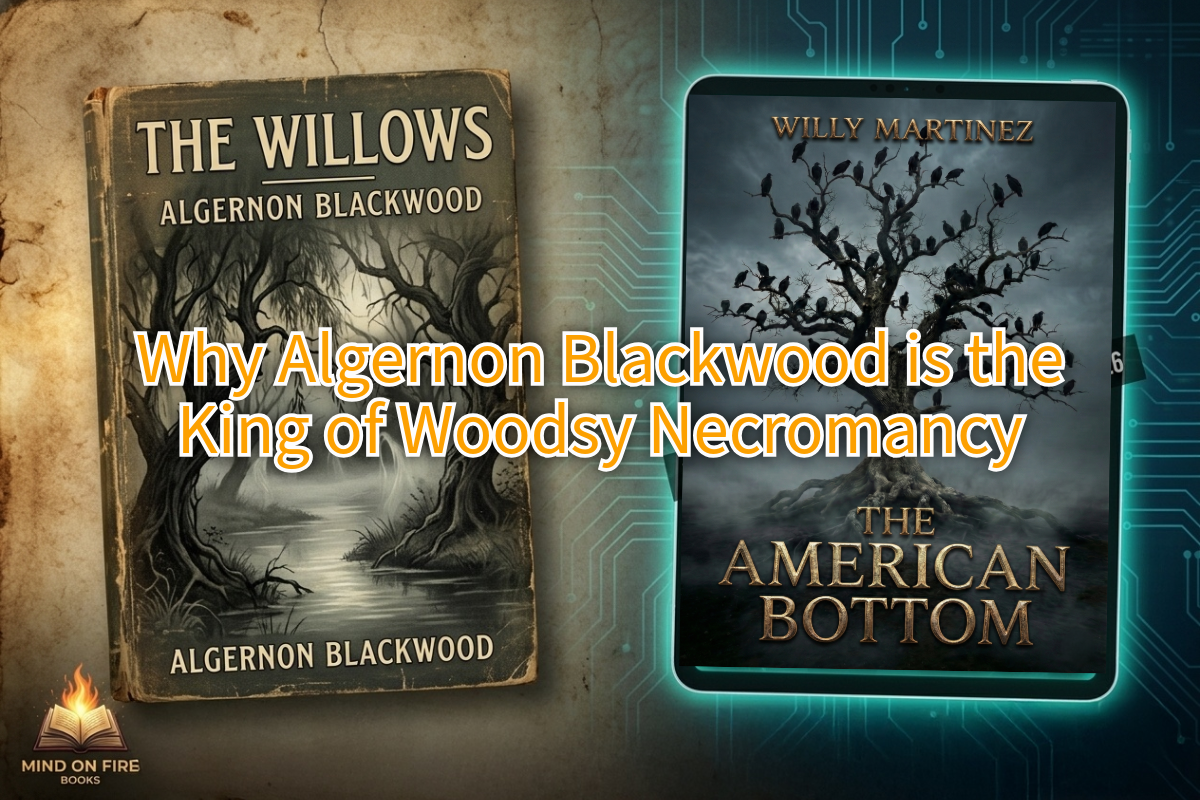
Authors often talk about the “10-year siege” of the indie publishing life. To survive that siege, you need a foundation of steel and a library of shadows. This May, the industry is leaning into “bold, strange, and unapologetically speculative” works. But as authors dive into the “Woodsy Necromancy” craze, they are standing on the shoulders of a titan: Algernon Blackwood.
The Living Landscape
So far, 2026 is defined by a return to the soil. Whether it’s the “insect horror” found in Wolf Worm or the “hallucinogenic” gas-giant monsters of Jupiter, we are obsessed with environments that are actively trying to consume us. This is the essence of Eco-Horror, and no one did it better than Blackwood.
Featured Public Domain Work: Excerpt from “The Willows”
Originally published in 1907, this passage perfectly captures the “Liminal Space” and “Gothic Folklore” vibes trending across social media today.
“The Willows” By Algernon Blackwood
“The looming of the great spirits of the place was beginning to be felt… they were the watchers, the spirits of the willows, and they were beginning to stir. The wind, instead of blowing the mist away, seemed to be blowing it into shapes, and I saw a thousand forms of the dead, dancing in the spray of the river.”
Here is the Opening Paragraphs for The Willows by Algernon Blackwood
I.
After leaving Vienna, and long before you come to Budapest, the Danube enters a region of singular loneliness and desolation, where its waters spread away on all sides regardless of a main channel, and the country becomes a swamp for miles upon miles, covered by a vast sea of low willow-bushes. On the big maps this deserted area is painted in a fluffy blue, growing fainter in color as it leaves the banks, and across it may be seen in large straggling letters the word Sümpfe, meaning marshes.
In high flood this great acreage of sand, shingle-beds, and willow-grown islands is almost topped by the water, but in normal seasons the bushes bend and rustle in the free winds, showing their silver leaves to the sunshine in an ever-moving plain of bewildering beauty. These willows never attain to the dignity of trees; they have no rigid trunks; they remain humble bushes, with rounded tops and soft outline, swaying on slender stems that answer to the least pressure of the wind; supple as grasses, and so continually shifting that they somehow give the impression that the entire plain is moving and alive. For the wind sends waves rising and falling over the whole surface, waves of leaves instead of waves of water, green swells like the sea, too, until the branches turn and lift, and then silvery white as their underside turns to the sun.
Happy to slip beyond the control of the stern banks, the Danube here wanders about at will among the intricate network of channels intersecting the islands everywhere with broad avenues down which the waters pour with a shouting sound; making whirlpools, eddies, and foaming rapids; tearing at the sandy banks; carrying away masses of shore and willow-clumps; and forming new islands innumerably which shift daily in size and shape and possess at best an impermanent life, since the flood-time obliterates their very existence.
Properly speaking, this fascinating part of the river’s life begins soon after leaving Pressburg, and we, in our Canadian canoe, with gipsy tent and frying-pan on board, reached it on the crest of a rising flood about mid-July. That very same morning, when the sky was reddening before sunrise, we had slipped swiftly through still-sleeping Vienna, leaving it a couple of hours later a mere patch of smoke against the blue hills of the Wienerwald on the horizon; we had breakfasted below Fischeramend under a grove of birch trees roaring in the wind; and had then swept on the tearing current past Orth, Hainburg, Petronell (the old Roman Carnuntum of Marcus Aurelius), and so under the frowning heights of Thelsen on a spur of the Carpathians, where the March steals in quietly from the left and the frontier is crossed between Austria and Hungary.
Read the full text at Project Gutenberg, here.
Based on your taste in literature, I think we could be good friends. Sign up below for the archive below and free eBook giveaways.
Why This Works for Indie Authors Today
For the modern indie lit creator, Blackwood’s work provides a masterclass in building tension without over-explaining the monster. As we see a surge in “Gothic Fantasy” titles like Innamorata, authors are rediscovering that the most effective horror lies in the atmosphere of a place. Blackwood didn’t just write about woods; he wrote about the “vast spirit of un-restful things” that lives within them.
Read the full text at Project Gutenberg, here.
Which public domain master fuels your dark imagination?
Thank you for visiting with us. For more Interviews or Literature related content, visit our blog at The Ritual. Copyright Mind on Fire Books.





Leave a Reply