
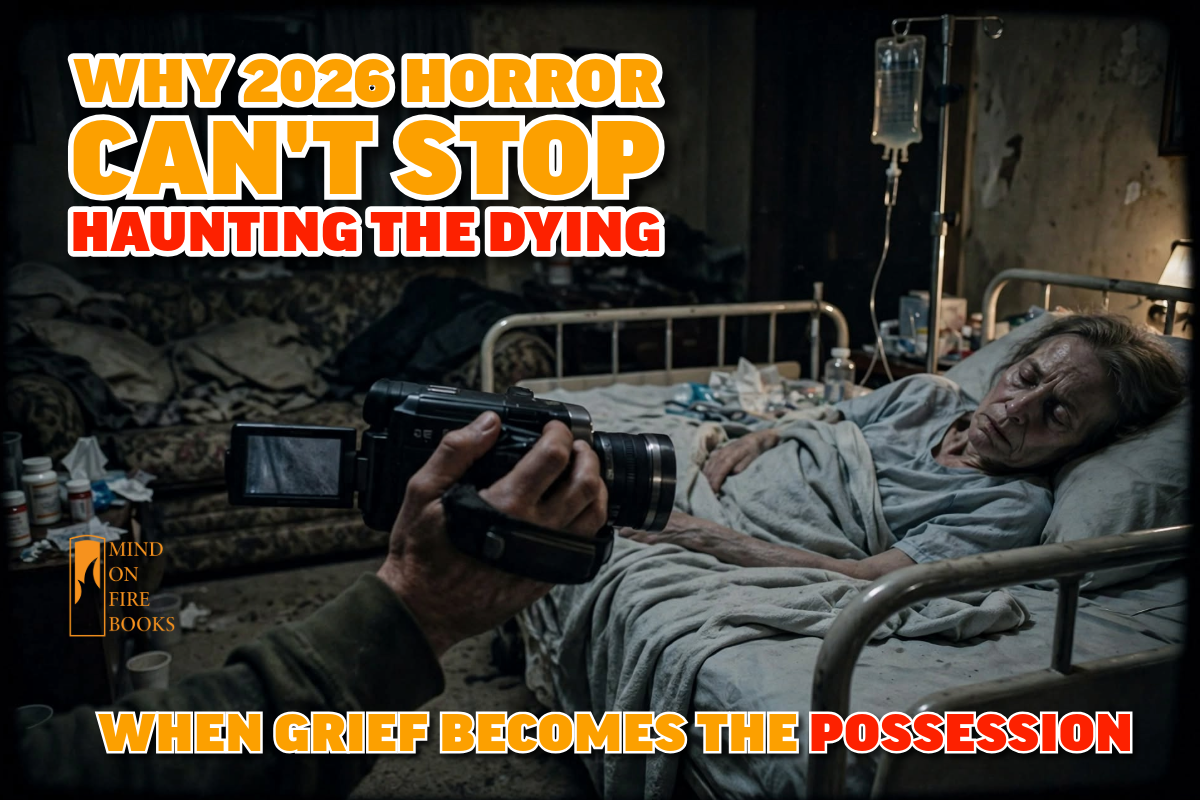
Most possession movies start with a Ouija board. Real-life possession starts with a diagnosis.
I watched the trailer for A Possession in Lincoln County twice. Once as a horror fan who lives for found-footage dread. The second time as a guy who has watched someone get that phone call where a doctor says, “we’ve done all we can.”
I scored the premise ☕☕☕☕ in my last piece A Possession in Lincoln County. But I couldn’t shake the real monster. It’s not the thing with red eyes on the poster.
It’s grief. And in 2026, grief has become the ultimate parasite.
The Bones: Three Times Grief Wore a Demon Suit
We’ve been building to this for a decade.
1. The Babadook (2014) – Grief as a children’s book you can’t close.
Amelia doesn’t get haunted because she’s a bad mother. She gets haunted because she never got to mourn. The Babadook isn’t an intruder. It’s unprocessed loss with teeth.
2. Hereditary (2018) to Talk to Me (2023) – Grief as inherited disease.
We stopped asking “is the house haunted?” and started asking “is the family haunted?” Trauma became contagion. You don’t catch it from a graveyard, you catch it from your bloodline.
3. Family + A Possession in Lincoln County (2026) – Anticipatory Grief.
And here’s where it gets nasty and new.
Family, which just played the festival circuit, is about a kid watching his father physically deteriorate from cancer. The director said he started writing it after his own dad died when he was 14. What he nailed is something we don’t have a name for in everyday language: anticipatory grief. The mourning you do before the person dies. The brain trying to rehearse an absence it can’t comprehend.
Jake in Lincoln County is living in that exact same gap. His wife is still breathing, but the system has already declared her gone. Terminal. That word does so much violence in one little clinical package.
Horror in 2026 isn’t about what happens after death. It’s about the long, awful hallway before it.
The Body as a Failing State
Here’s where I put my Mind on Fire hat on.
Michel Foucault talked about the clinical gaze — that moment when the doctor looks at you and you stop being a person and start being a case file. A terminal diagnosis is the state, operating through objective rationalism, declaring your body eminent domain.
Your body becomes property of the hospital. Of the chart. Of the statistics.
So what does Jake do? He commits parrhesia. Fearless truth-telling from a position of absolute powerlessness. He says: “No. You don’t get to tell me when she’s over. I will find another authority.”
And the only other authority left that deals in life and death is the occult.
That line I wrote last time keeps ringing in my head: “The camera doesn’t just capture the devil; it captures the desperate, violent lengths a man will go to when the biological hierarchy of his life collapses.”
The demonic ritual isn’t evil. It’s a man trying to steal his wife back from the system that already buried her.
Possession is just grief with better PR.
The Real Monster (And Why I Wrote It Too)
If you’ve read my collection Folklore and Flesh, you know I’m obsessed with this exact border — where transformation stops being folklore and starts being flesh.

I didn’t plan it as grief horror. I planned it as body horror. But bodies betray us because we love people. That’s the whole curse.
Three stories in there live in this same hallway as Lincoln County:
The Whispering Bone Orchard — A grieving mother goes to a shaman in a haunted grove and becomes the village’s living archive. She doesn’t want closure. She wants storage. Where do you put a love that has nowhere to go?
Clay and Memory — A widower tries an AI therapist and a “quantum clay” ritual to bring his wife back. His memories leave first. Then his name. It’s about what we’ll trade to keep editing the past.
Hannah and the Demon’s Canvas — In the ruins of Nagasaki, Hana Takahashi trades grief for a second mouth and a vengeance that won’t stay buried. Sometimes grief doesn’t want healing. It wants a body.
Your ancestors didn’t invent rituals to honor the earth; they invented them to keep the rot at bay. Jake in Lincoln County is just doing what we’ve always done. When medicine says “no,” we find a grove, a ritual, a demon who will at least take our call.
If that particular dread keeps you up at 3am, the signed, hand-stamped edition of Folklore and Flesh is $6.66 direct from me this October — because Amazon gets our leftovers and hunters of insight deserve the artifact. You get the paperback plus the ebook. Grab the artifact here: https://mindonfirebooks.com/product/folklore-and-flesh-signed-paperback/
125 pages. Zero filler. Pure concentrated dread.

Final Sip
I score the grief-as-parasite trope in 2026: ☕☕☕☕☕
Five mugs. Not because it’s fun. Because it’s honest. Jump scares make you flinch. Grief horror makes you sit in silence after the credits and text someone you love.
So let me ask you the Mind on Fire question:
When Jake performs that ritual, is it possession?
Or is it the first time in months that someone has actually listened to him say “I can’t lose her” and answered back?
Are you watching the storm, or are you checking the foundation?
Drop your take below. And if you’ve lived in that hallway between diagnosis and death — what was your ritual?
Thank you for visiting with us. For more Reviews or Literature related content, visit our blog at The Ritual. Copyright Mind on Fire Books.



Leave a Reply