
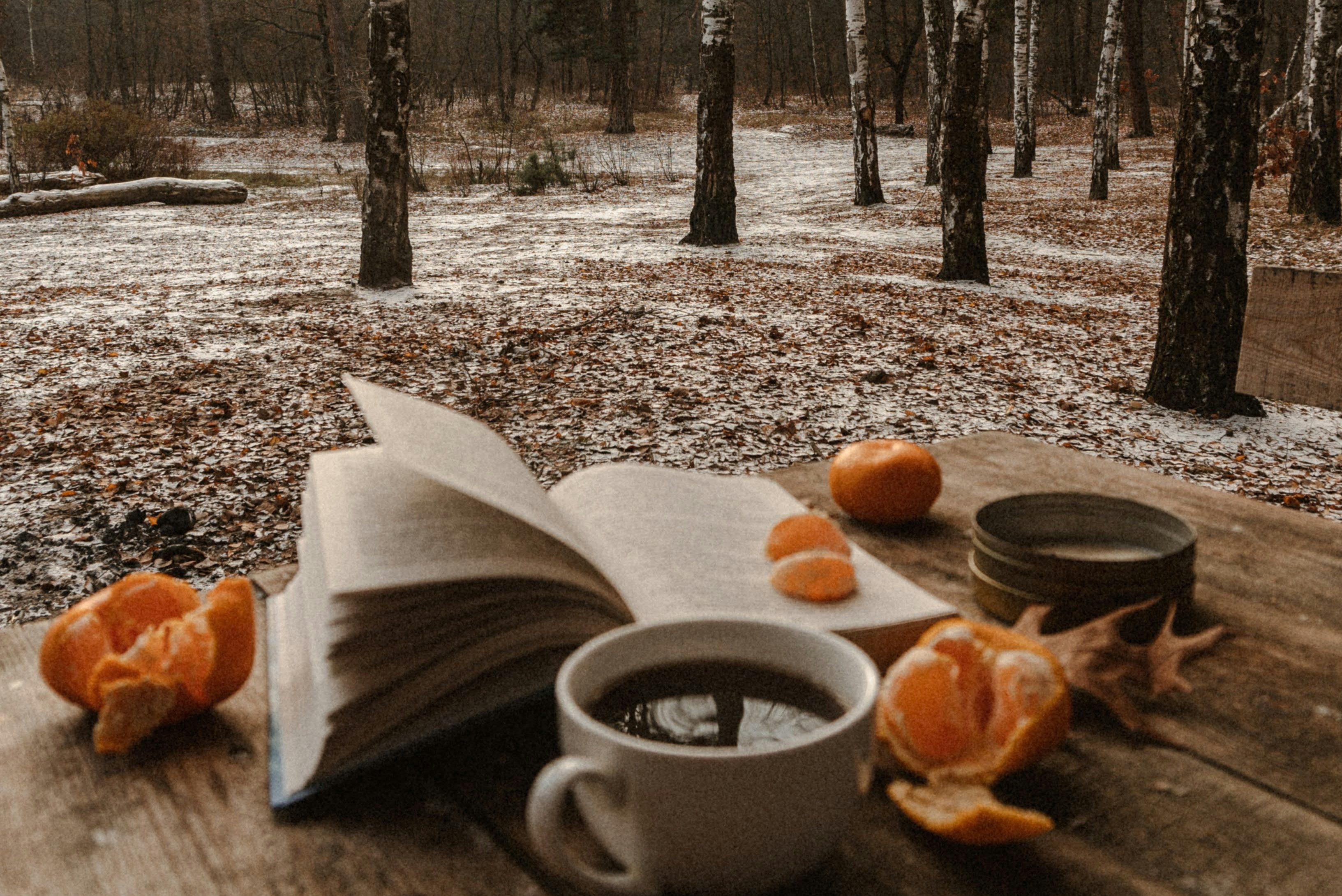
Strange books, dark books, beautiful books, and a few stories for readers who prefer their holidays slightly haunted. (Photo by Yuliia Tretynychenko on Unsplash)
There is something about this part of the year that makes me want to disappear into a book.
Maybe it is biological.
The light goes early. The trees empty themselves. We begin gathering around tables with people we love, tolerate, miss, remember, or occasionally hide from in another room.
Somewhere between the Thanksgiving leftovers and that strange, nearly forgotten week after Christmas, time begins to loosen.
I do not necessarily want Christmas books. I want books that feel right when the world gets dark at five o’clock. Give me a little mystery. A little folklore. Something strange enough to make me forget whatever is glowing on my phone.
Instead of putting together another holiday gift guide filled with books I have never read, I returned to stories I have actually spent time with over the past couple of years. These are books I have reviewed, written about, argued with, recommended, or simply could not shake.
I have also included a few new and upcoming titles currently sitting on my winter radar.
Think of this less as a ranking and more as a table.
Pull up a chair. Take what looks good. Leave something for the next person.
For the Reader Who Wants to Get Lost: Kafka on the Shore by Haruki Murakami
I keep returning to Murakami because he understands something about dreams that many writers do not.
Dreams are not strange while we are inside them.
They are perfectly reasonable. It is only after we wake that we realize something was wrong.
That is part of what makes Kafka on the Shore work so beautifully. Reality does not exactly collapse. It loosens.
Cats speak. Fish fall from the sky. Memory becomes geography. Identity becomes something you can wander into and perhaps never completely wander back out of.
When I reviewed the novel, it fit naturally beside the stories I already gravitate toward: stories in which the border between the physical world and whatever waits underneath it becomes dangerously thin.
Winter is the perfect time for a book like that. Do not solve it.
Just enter.

For the Gothic Reader: My Darling Dreadful Thing by Johanna van Veen
This is the book for the person who wants holiday reading filled with candlelight, old rooms, unhealthy attachments, unreliable perceptions, and the creeping suspicion that something in the house knows more than it should.
Which, honestly, sounds a little like Christmas with extended family.
What stayed with me about My Darling Dreadful Thing was the way psychological fracture and Gothic atmosphere begin feeding one another.

That is the kind of horror I tend to prefer.
A monster is not interesting merely because it is frightening. It becomes interesting when we can no longer tell where the monster ends and the human being begins.
Read this one when the house is quiet. Preferably after everyone else has gone to bed.

Based on your taste in literature, I think we could be good friends. Sign up below for the archive below and free eBook giveaways.
For the Person Who Thinks They Don’t Like Science Fiction: Fuzzy Nation by John Scalzi
Sometimes we need a break from ghosts.
Enter Jack Holloway.
He is difficult. He is self-interested. And, he’s frequently an asshole.
Unfortunately, he is also frequently right.
That tension is part of what made Fuzzy Nation such a pleasure for me. Beneath its science-fiction architecture is a sharp argument about corporate power, environmental exploitation, personhood, and the enormously inconvenient question of what human beings are willing to destroy once money becomes involved.
When I reviewed it, I called it science fiction’s sharpest eco-legal thriller. It’s funny, smart, and it moves.
More importantly, it gives you something to argue about after you finish. Those are underrated qualities in a holiday book.

For the Reader Who Wants to Leave Earth Entirely: Artemis by Andy Weir
Sometimes December requires escape.
Not metaphorical escape. Literal Moon escape.
I had a good time with Andy Weir’s Artemis because it understands the particular pleasure of a caper. The novel combines life on the Moon with the machinery of a criminal scheme, creating a story that keeps moving without demanding that every page stare into the abyss.
Not every winter book needs to confront the ancient darkness beneath human consciousness.
Sometimes you want to steal something on the Moon.
Perfectly reasonable.

For the Reader Who Wants Winter to Feel Colder: Skandinavien
There are stories about winter. Then there are stories that somehow make the room feel colder.
Skandinavien landed in that second category for me. When I reviewed it, I described it as frostbitten, cinematic audio horror. That remains the best way I know to describe the experience.
This is the one I would recommend when holiday travel leaves you with hours in the car.
Turn up the heat. Let the landscape slide past the windows. Allow the road to become considerably stranger. Not every story on a winter list needs to arrive between two covers.
Some of them need to whisper through the speakers while darkness gathers beyond the windshield.

For the Folk-Horror Viewer: Mother of Flies
Mother of Flies is not a book, but it belongs in this winter ritual.
There are certain stories that do not feel invented.
They feel unearthed. That is what I want from folk horror. I do not want someone simply placing a monster in the woods. I want the woods themselves to feel complicit.
That is part of what drew me to Mother of Flies, a film I described as a witch-stained slow burn that crawls under the skin.
The best folk horror understands that land remembers. Families remember. Bodies remember.
Sometimes the thing coming after us is not new at all.
We have simply forgotten its name.

New Books on My Winter Radar
The fun of creating a holiday reading list in November is knowing that the year is not finished with us yet.
There are still strange things crawling toward the bookshelf.
The following books caught my attention because each appears to be working within territory that we will recognize: obsession, haunted places, transformation, dangerous knowledge, psychological fracture, and human bodies placed under impossible pressure.
I have not reviewed these titles yet. Consider them invitations rather than verdicts.
Basilisk by Matt Wixey
This one immediately caught my attention. Basilisk centers on an ethical hacker drawn into a mysterious game involving puzzles and a dangerous cognitive weapon.
Technology. Obsession. Puzzles. Information that perhaps should remain unknown.
Yeah. I’m listening.
Stories about dangerous information work because they transform knowledge into a threshold. The question is no longer whether a character can discover the truth. The question becomes whether that truth can be survived.
Behind the Gate by Amparo Dávila
This may be the book I am most curious about.
Behind the Gate has been described as Gothic, dark, surreal, and atmospheric, with stories circling obsession and the uncertain boundary between sanity and madness.
Those are essentially four words someone could use to lure me into an abandoned building.
The collection’s shorter form also makes it well suited to those strange pockets of time surrounding Thanksgiving and Christmas. You can enter one story while the rest of the house sleeps, then return to the surface before anyone notices you were gone.
Assuming you return at all.
Chimera Skin by Johnny Compton
Then there is Chimera Skin.
The book follows a mutated man struggling to retain his sanity in a devastated world.
Anyone familiar with what I have been exploring through folk and body horror probably understands why the word “mutated” immediately caught my attention.
Body horror is most effective when transformation means more than mutilation. The altered body becomes evidence. It records what the world has done to us, what we have done to ourselves, and what we may be forced to become in order to survive.
This one is firmly on my radar.
Cold Empty Rooms by Andy Marino
A couple inherits an old manor.
They hear voices.
A mysterious presence begins making requests.
You can probably already see where my interest begins.
What catches my attention here is the possibility that Cold Empty Rooms may be interested in more than the mechanics of a haunted-house ride. Its premise points toward sorrow, outsiders, and the promises people make to whatever waits inside a home.
A haunted house becomes much more interesting when the presence inside it does not merely want to frighten us.
It wants something.
And sooner or later, someone has to answer.
Keep Watching the Winter Shelves
Publishing may slow as the year closes, but winter reading does not end with Christmas.
New horror, fantasy, speculative fiction, and strange literary work will continue finding its way into the world. Some of it will arrive loudly. Other books will appear with little ceremony, waiting for the right reader to discover them.
So consider this list unfinished.
That is part of the fun.
A reading list should not feel like a locked room. It should feel like a doorway.
The Book I Obviously Have to Put on the Table: Folklore and Flesh
Look. It is my website. I am allowed one shameless recommendation.
If the books above share any DNA with my own work, it is probably this:

The world is stranger than we are willing to admit, and the human body is considerably less permanent than we would like to believe.
That is the territory I wander through in Folklore and Flesh: ancient stories colliding with modern anxieties, folklore becoming physical, and people discovering that whatever lives in the landscape is not particularly interested in remaining metaphorical.
The collection contains ten stories and twelve poems built around folklore, transformation, trauma, and the body.
If you are not ready to enter the entire collection, I have also made four complete stories and four poems available in the free sampler.
Consider it my contribution to the winter fire.
Read Something Strange This Winter
Books make good gifts. But that is not really why I am writing this.
The older I get, the more I appreciate those rare stretches of the year when the world quietly gives us permission to stop.

Thanksgiving passes. The dishes disappear. Christmas lights burn in windows. People fall asleep on couches.
For a few hours, nobody needs anything from you. Hopefully. Take the opportunity. Make some coffee. Pour something stronger. Find the chair everyone else has forgotten.
Open a book. Read something funny. Read something terrifying or something that makes you uncomfortable. Find something that follows you upstairs after you close the cover.
The nights are long.
We might as well put something strange inside them.
Thank you for visiting with me. For more Reviews or Literature related content, visit our blog at The Ritual. Copyright Mind on Fire Books.
Based on your taste in literature, I think we could be good friends. Sign up below for the archive below and free eBook giveaways.



Leave a Reply