
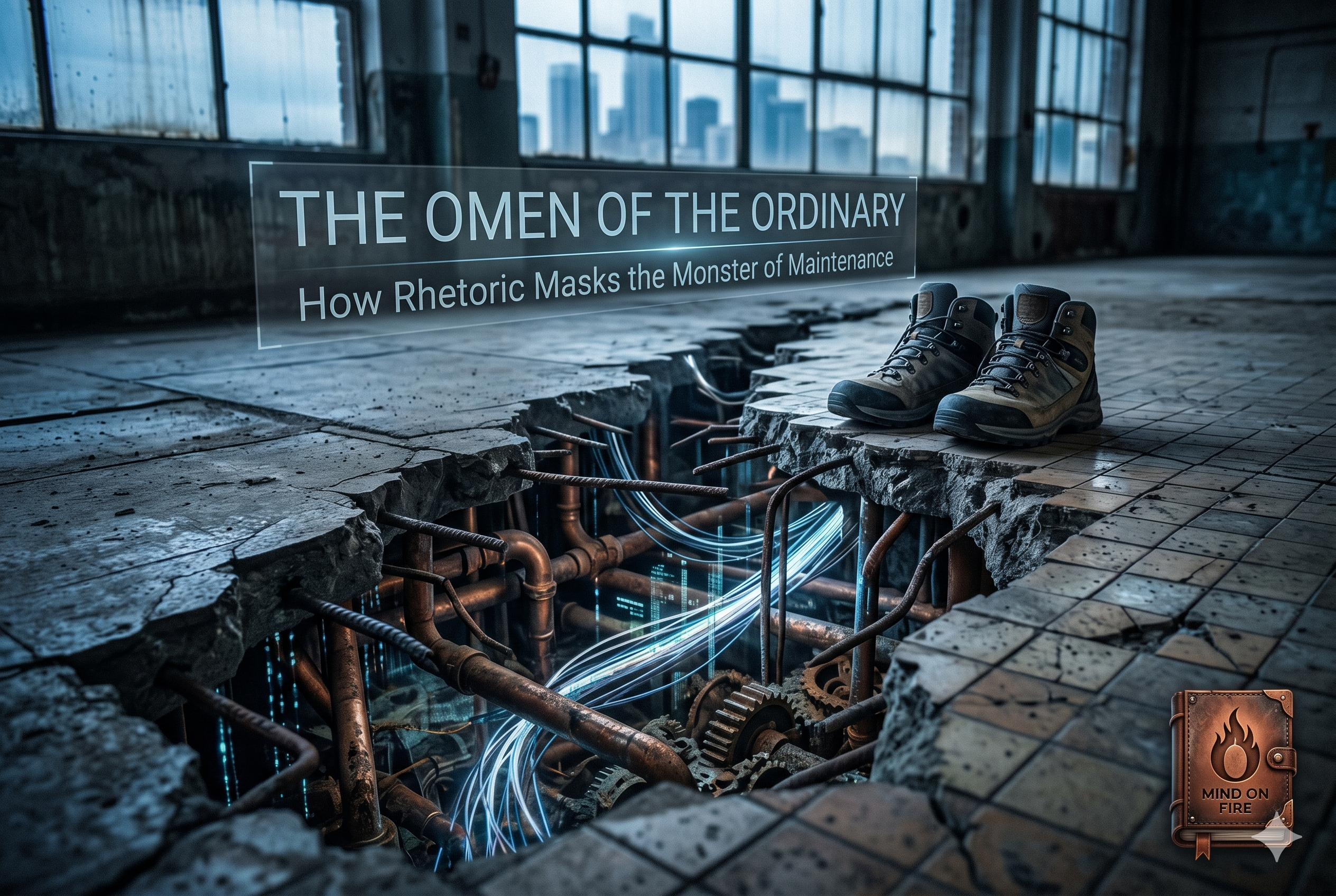
Most horror stories start with a scream. Real-life horror starts with a shrug.
In our previous explorations, we’ve discussed how fear is used as a “parasite of perspective.” We also explored how your internal “sentinel” is being gaslit. Today, I want to talk about the most terrifying trope in the dark fantasy playbook: The Monster of Maintenance.
The Spectacular vs. The Structural
In the horror genre, we often focus on the Inciting Incident—the moment the ghost appears or the killer strikes. This is what sociologist Barry Glassner, in The Culture of Fear, identifies as our obsession with the “spectacular.” We are rhetorically primed to fear the sudden, the violent, and the cinematic.
But the real horror—the one that actually ends civilizations—is what anthropologist Joseph Tainter calls the cost of complexity. In The Collapse of Complex Societies, Tainter argues that as systems become more intricate, they require more energy and resources just to stay the same. Eventually, you aren’t building anything new. Instead, you are just desperately patching the cracks in a Gothic ruin that is too big to save.
The rhetoric of fear works to ensure you only look for the “spectacular” monster. Meanwhile, the “ordinary” monster—the failure to maintain the water lines, the power grid, and the social contract—slowly consumes the foundation.

The “Everything is Fine” Trope
In every haunted house story, there is a character who insists that the blood dripping from the walls is just “leaky pipes.” In our modern discourse, this is the Rhetoric of the Normal.
- The Trope: Denial in the face of the supernatural.
- The Reality: We are told that rising costs, failing services, and systemic glitches are just “temporary market adjustments” or “the cost of doing business.”
This is a rhetorical strategy designed to keep you from realizing that the “pipes” aren’t just leaky—the house is rejecting its inhabitants. In fact, by framing systemic failure as a series of isolated, ordinary inconveniences, the rhetoric of fear prevents a collective recognition of the Pattern of Collapse.

Seizing the Narrative of the Mundane
To survive a dark fantasy, the protagonist must look past the jump scares and examine the plumbing. You must become a scholar of the “ordinary” horror.
- Audit the “Boring” Cracks: Pay attention to the things the media ignores because they aren’t “exciting.” A bridge closure is a more honest omen than a political scandal.
- Reject the Spectacle: When you are told to be terrified of a distant, cinematic threat, ask yourself: What is crumbling right under my feet while I’m looking at the horizon?
- Harden Your Own “Castle”: If the macro-systems are entering a Tainter-style collapse, your micro-systems (your home, your local community, your personal skills) must be simplified and reinforced. Importantly, read my article on “Harden Your Own “Castle”: If the macro-systems are entering a Tainter-style collapse, your micro-systems (your home, your local community, your personal skills) must be simplified and reinforced. Furthermore, read my article on “Why Environmental Dread is the New Horror“
The sun is up now, and the world looks solid. But remember: a house doesn’t fall all at once. it falls one unpatched leak at a time. The rhetoric of fear wants you to watch for the lightning strike. I’m telling you to watch the water damage.
Stay awake. Stay vigilant. And never trust a narrative that tells you the scratching in the walls is “just the wind.”
Are you watching the storm, or are you checking the foundation?
- Read my latest dark fiction release, Folklore and Flesh, where the real villain is the bureaucracy that let the dragons in.
- Join the Conversation: What is one “ordinary” thing in your city that feels like a warning sign no one is talking about?
Thank you for visiting with me. For more Rhetoric or Literature related content, visit my blog at The Ritual.



Leave a Reply