
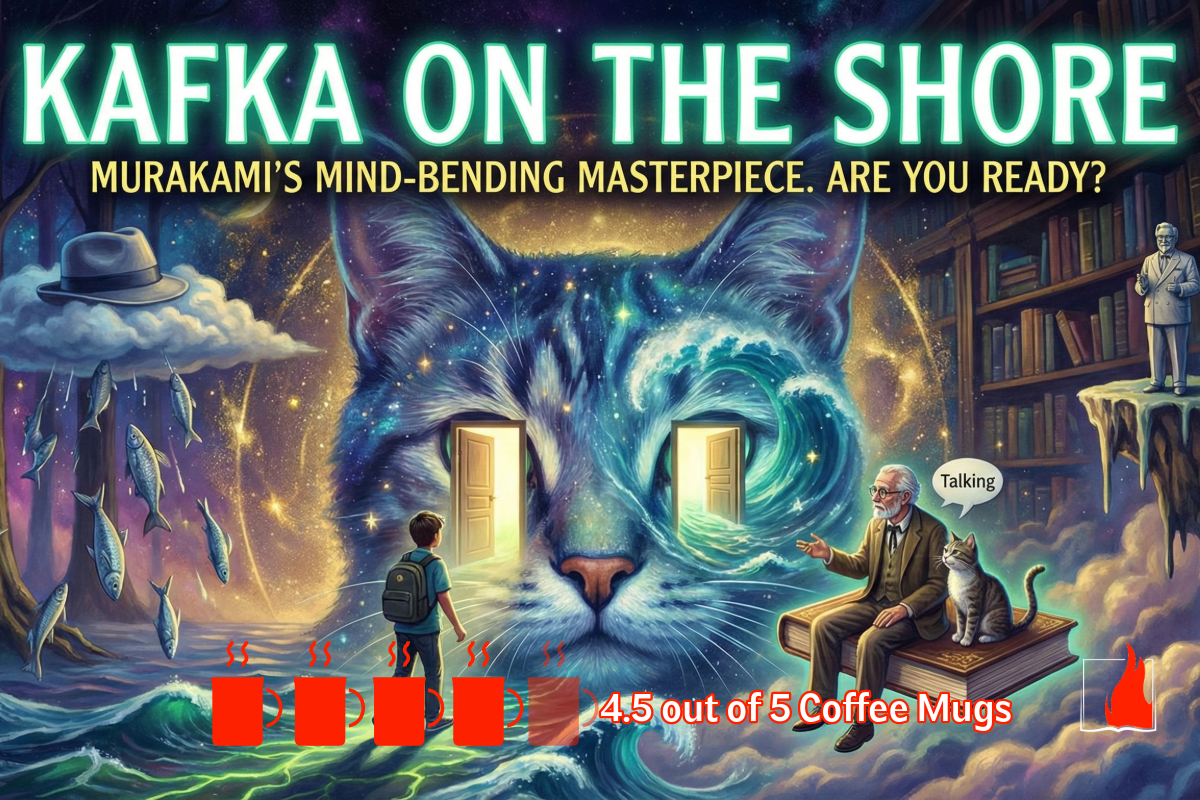
A Metaphysical Odyssey of Memory and Fate
With Kafka on the Shore, Haruki Murakami has constructed a novel every bit as ambitious and expansive as his celebrated The Wind-Up Bird Chronicle. It is a work acclaimed globally for its uncommon scope, and judging by the sheer density of its symbolism and emotional resonance, it is a text that will be dissected and admired for decades to come.
Rating: 4.5/5 Coffee Mugs ☕☕☕☕☕
If you are seeking a narrative that challenges the laws of physics, subverts narrative convention, and demands total immersion, you have found it. Here is my definitive review of Kafka on the Shore.

The Reading Experience: A Labyrinth of Dream Logic
I have just emerged from the depths of Kafka on the Shore, and I use the word “emerged” deliberately. Reading this novel is less like processing text and more like waking from a vivid, prolonged fever dream. Initially, I was intimidated by its reputation; Murakami is known for his density and surrealism, and the prospect of navigating metaphysical riddles—and conversational cats—was daunting.
However, the surrender to Murakami’s world is where the magic lies. The book pulls the reader into a state where the impossible becomes mundane. I found myself accepting philosophical debates between felines and rainstorms of leeches as casually as one accepts the weather. Yet, this is not surrealism for its own sake. It is deeply, achingly emotional. By the time the parallel narratives of the teenage Kafka and the aging Nakata intersected, I felt I had undergone a psychological shift. It is a rare book that alters the texture of your own reality while you are reading it.

Follow Mind on Fire on Social Media
A Living, Breathing Myth: Critical Consensus
To classify this novel is difficult, but it is undeniably a tour de force of metaphysical reality. Kirkus Reviews has rightfully called it “a masterpiece, entirely Nobel‑worthy,” specifically praising the dual-narrative structure.
Readers and critics generally agree on the novel’s power to mesmerize. As noted in discussions on Goodreads, the imagery is unforgettable: ghostlike pimps, Hegel-quoting prostitutes, and forests that harbor soldiers unaged since World War II. It is a book that refuses to be forgotten.
The Literary Controversy
However, a professional review must address the polarization surrounding the work. As evidenced by heated threads on Reddit, Kafka on the Shore is a divisive emotional experience.
- The connection: Some readers feel deeply moved by Kafka’s isolation, viewing it as a mirror to their own longing for transformation.
- The alienation: Others find the ambiguity frustrating or the narrative logic too elusive.
- The critiques: There are valid literary criticisms regarding Murakami’s portrayal of women and the handling of the Oedipal prophecy, which some find forced.
This tension—between transcendence and confusion—is the engine that keeps the book alive in public discourse. It demands that the reader take a stance.
Themes for Discussion
Kafka on the Shore is not a puzzle to be solved, but an experience to be inhabited. It explores core motifs that make it an exceptional choice for literary analysis:
- Fate vs. Free Will: We are asked to consider if Kafka is escaping his destiny or sprinting toward it.
- The Fluidity of Time: Memories and ghosts (including the “Colonel Sanders” figure) suggest that time is not linear, but a container we step in and out of.
- Identity as Multiplicity: Characters exist as ghosts, spirits, and physical bodies simultaneously.
The Verdict
Is this a perfect novel? Perhaps not in the traditional sense. But it is a masterpiece of the surreal. I recommend it to those who enjoy fiction that dismantles their perception of reality. I advise against it for those who require linear plots and tidy resolutions.
Rating: ⭐⭐⭐⭐½ (4.5/5) A near-perfect brew of the surreal, complex, and haunting.


A Dark Fiction Collection of Folklore and Body Horror
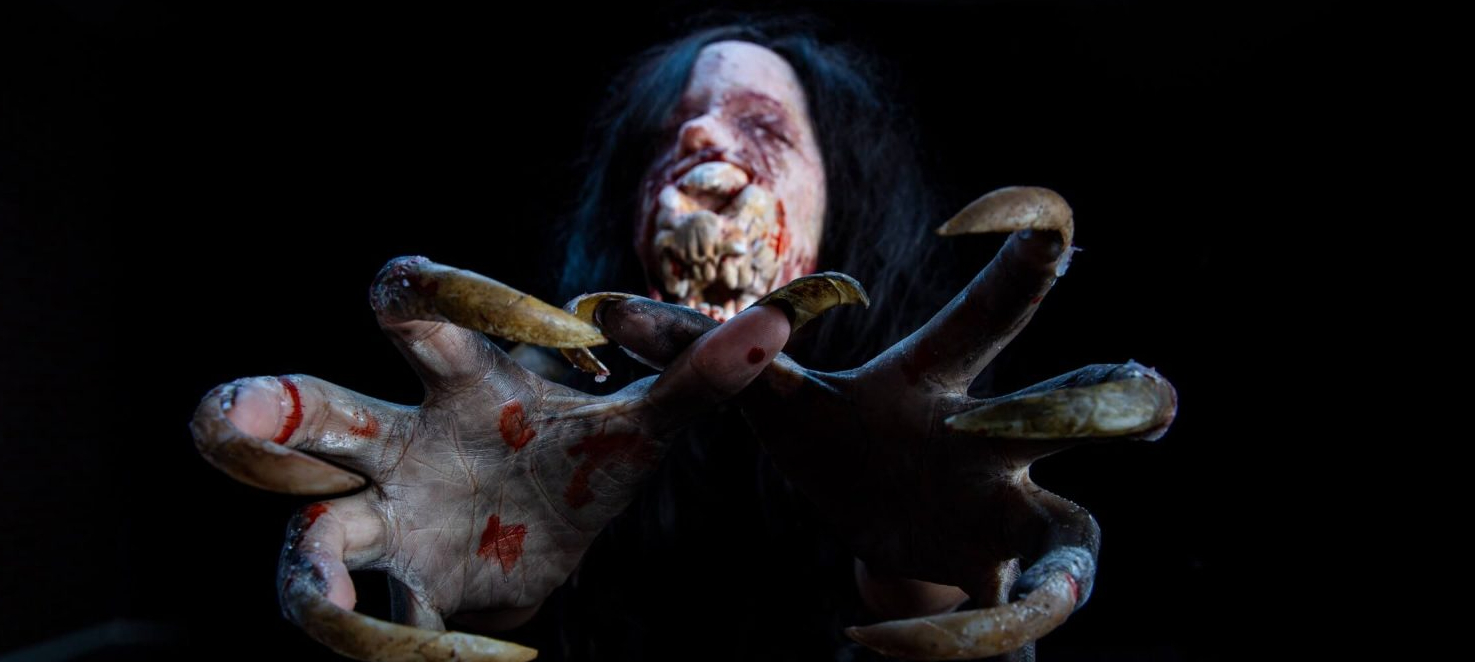
Folklore and Flesh is a masterwork of dread operating at the convergence of two primal anxieties: the terror of the isolated environment and the fear of the body betraying itself. In exploring these tensions, we must consider what makes us human or drone. This is Folk Body Horror: a fusion of ancient cultural dread and grotesque physical transformation.
In this collection of dark stories and poetry, the boundary between myth and matter collapses. The tales explore the uncanny territory where ancestral lore ceases to be a cautionary story and becomes a biological instruction manual for corruption.
This collection binds 10 creative short stories and a dozen visceral poems.
Synopsis of Kafka on the Shore
Two lives move toward each other like mirrored myths.
Kafka Tamura, a fifteen‑year‑old runaway, flees his father’s dark prophecy and searches for the mother and sister who vanished from his life. His escape leads him to a quiet private library in Takamatsu, where he meets Oshima, a sharp, enigmatic librarian, and Miss Saeki, a woman haunted by a past self who may or may not be connected to Kafka’s own fractured history. As Kafka drifts deeper into the library’s dreamlike gravity, time begins to fold, memories take physical shape, and the boundary between waking and dreaming dissolves.
Meanwhile, in a parallel thread, Nakata, an elderly man who lost his intelligence in a mysterious childhood incident, discovers he can speak to cats. His simple life is disrupted when a violent encounter pushes him onto a cross‑country journey with Hoshino, a truck driver who becomes his unlikely companion. Their path grows stranger by the mile — fish rain from the sky, a metaphysical “entrance stone” appears, and a slick, supernatural figure resembling Colonel Sanders nudges them toward a cosmic task.
As the two narratives spiral toward each other, the novel explores fate, identity, memory, and the invisible threads that bind people across time and consciousness. The ending refuses to close the loop neatly — instead, it leaves readers suspended in a space where logic, myth, and emotion coexist.
Thank you for visiting with me. For more Reviews or Literature related content, visit my blog at The Ritual. Copyright Mind on Fire Books.
Unearth More Bookish Treasures


Leave a Reply