
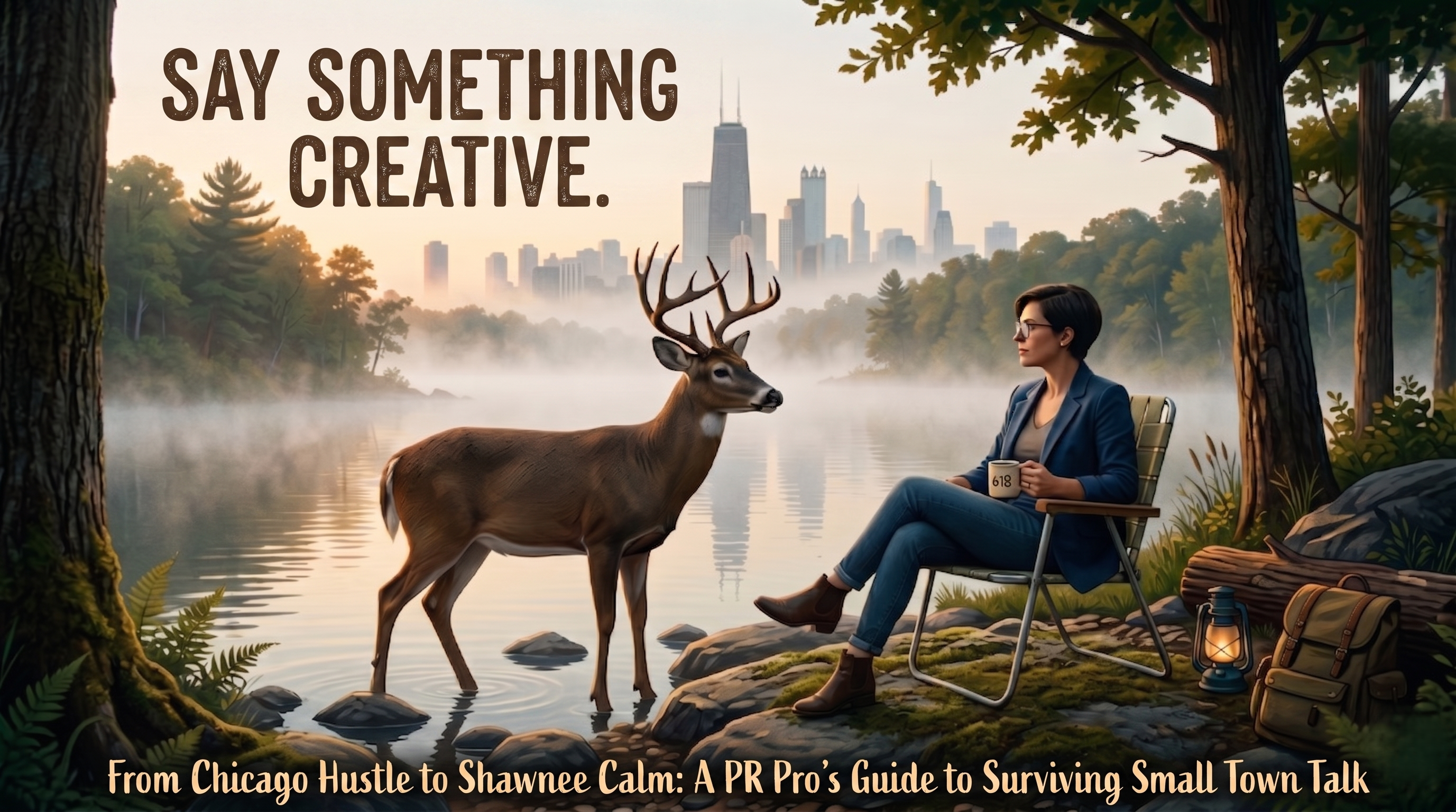
I spent the first part of my life navigating the Chicago suburbs, commuting into the city, and soaking up the sun in California. In those places, small talk is an Olympic sport you play to get away from people. You say “How’s it going?” while walking at 4 miles per hour, never expecting an actual answer.
Then, I moved to Carbondale, Illinois.
Suddenly, the “keep your head down” strategy didn’t work. I quickly learned that in Southern Illinois, a “quick trip” to the store is a 45-minute social commitment. If you don’t stop to discuss the deer population or the local high school sports, the rumor mill decides you’re either a secret agent or just incredibly “stuck up.”
For 12 years, I worked in Public Relations in Marion. Talk about a trial by fire. My job was to be the bridge between stories and people in a region where a handshake means more than a LinkedIn endorsement. I had to become a Social Alchemist, turning the “polite interrogation” of small-town life into genuine, often hilarious, connections.
Now, I live in Carterville, nestled right against the Shawnee and Crab Orchard Lake. It’s even smaller, even quieter, and the small talk stakes are even higher. Here is how I—an artsy, city-seasoned PR pro—survive the “Shawnee Gauntlet” with a little bit of weirdness and a lot of heart.
1. Treat Small Talk Like a Narrative Writing Prompt
When I was interviewing a local Veteran and farmer who clearly didn’t want to talk to a “PR person,” I stopped asking about his military service and farm crops and asked if he thought the crows in his field were “planning a coup.” He laughed for 2 minutes and shortly afterwards began to tell me about his life before being drafted.
- The Lesson: If you’re bored, your audience is bored.
- The Pro-Tip: Instead of “How are you?” try: “On a scale of ‘cozy cottagecore’ to ‘impending dystopian thriller,’ how is your Monday going?”

2. The “Glitch in the Matrix” Strategy
As a natural introvert, I found that acknowledging the absurdity of life makes people like you instantly. It takes the pressure off “performing” being a normal human.
- The Anecdote: I once told a barista I was convinced my cat was a high-ranking government official because he watched C-SPAN with such intensity. We ended up talking for ten minutes about feline conspiracies.
- The Pro-Tip: If you feel awkward, lean into it. “I think the simulation is lagging today; I’ve seen that same red car drive past four times. Should we stay still until the next patch update?”
3. The Curator’s Eye (For the Artsy Souls)
Artsy people see the world differently—so use that! You don’t have to talk about the weather; talk about the vibe of the weather.
- The Quote: My old mentor once told me, “If you aren’t talking, you’re plotting.” I decided to start talking like a character in a gothic novel instead.
- The Pro-Tip: Give them a sensory detail. “The light hit the rusted dumpster behind the office in a way that was very ‘post-industrial melancholy.’ It really set the tone for my morning coffee.”
Based on your taste in literature, I think we could be good friends. Sign up below for the archive below and free eBook giveaways.
4. Blame the Algorithm
In the PR world, tech glitches are a constant. In small talk, they are a bridge.
- The Line: “My phone’s algorithm has decided I’m a professional falconer. I’ve never even touched a bird, but now I know where to buy a very specific leather glove. How’s your data-privacy-paranoia going today?”
5. The “Mystery Neighbor” Hack
If you’re in a small town, everyone wants to know your business. Give them a “teaser” instead of the whole book.
- The Line: “I’d tell you what’s in this package, but then the HOA might have to involve the paranormal investigators again. Better safe than sorry!”
The Takeaway: Whether you’re in a skyscraper in Chicago or a cabin near Crab Orchard, people just want to connect. Being a “Social Alchemist” isn’t about being perfect; it’s about being willing to be a little bit “offbeat.”
In a town like Carterville, your neighbors aren’t just people you live next to—they’re your audience, your characters, and eventually, your friends. Don’t be afraid to trade a “fine, thanks” for a “I think my toaster is haunted.”
So, let’s practice: You’re at the Huck’s in Carbondale or Marion (population less than 20k). Someone asks, “Hot enough for ya?” What’s your “Social Alchemist” response?
Mine:
“I think the sun is just trying to bake us all into human cookies for the local Bigfoot population.”
Thank you for visiting with us. For more Interviews or Literature related content, visit our blog at The Ritual. Copyright Mind on Fire Books.





Leave a Reply