
The six-o’clock surrender arrives without a sound.
Work boots and loafers kicked into the corner, greasy takeout containers cooling on the laminate table, and that familiar, sterile blue flicker washing across glassy eyes. It is the great American sedative. Thirty-five years ago, David Foster Wallace diagnosed it in his landmark essay E Unibus Pluram: television and passive media do not merely entertain us; they act as a psychic shock absorber, insulating us from the raw, uncomfortable friction of actual living.
You sit on the edge of the sofa while someone scrolls through streaming menus for forty-five minutes, paralyzed by options they will forget ten minutes after falling asleep.
Internal monologue: How do you just let the clock bleed out like this? Are we alive in this room, or are we just waiting for tomorrow’s alarm?
To the room, this is “unwinding.” To anyone wired for creation, it feels like sitting in the lobby of a morgue.
Then comes the inevitable friction. Someone asks what you’ve been working on. You don’t offer the sanitized, polite answer—“Oh, just keeping busy”—you answer with the actual current running through your nervous system. You talk about the exact architecture of a sentence that fought you for three hours, or the mechanics of slipping an inside hook without exposing the chin.
The eyes opposite you glaze over, then dart away. A nervous laugh fills the gap. Later, the verdict trickles back through the grapevine:
“They’re just… a lot.” “Very intense.”

The Sanctuary of Full Contact
They call it intense because they do not have a framework for presence.
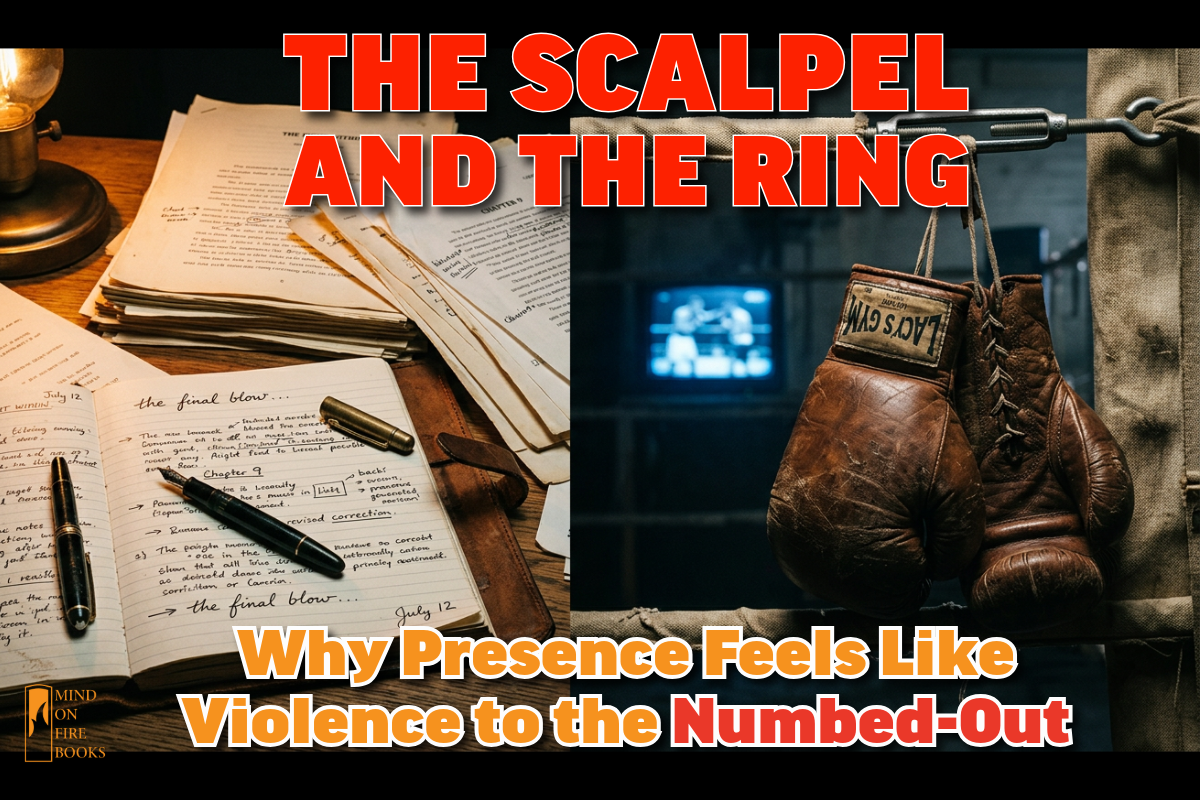
If your twin disciplines are writing and boxing, like mine, then your baseline reality is calibrated to high-stakes contact. Neither craft allows you to drift. Neither tolerates the passenger seat.
In On Boxing, Joyce Carol Oates observed that the ring is a sanctuary of the pure present tense. Inside the ropes, the past and future are incinerated. There is only the immediate millimeter of physical space, the rhythm of your opponent’s shoulder, and the consequence of your own balance. If your mind wanders to your email inbox or what you’re having for dinner, leather finds your jaw. The ring cures you of apathy in three-minute increments.
Writing demands the exact same merciless attention. As Norman Mailer noted in The Fight, the fighter and the writer share a singular dread: the instant you lie to yourself, you get exposed. On the page, passive clichés and lazy adjectives are the equivalent of dropping your guard. You have to hunt for the precise word with the same economy of motion a fighter uses to counter a jab.
When you spend your mornings cutting dead weight out of manuscripts and your evenings catching leather on the focus mitts, you are training your brain to reject padding. You operate without a buffer.
Based on your taste in literature, I think we could be good friends. Sign up below for the archive below and free eBook giveaways.
The Mirror Effect
When you carry that conditioning into everyday social circles, an accidental collision occurs.
You look people directly in the eye because you are listening to their cadences the same way you watch a sparring partner’s lead foot.
I’m used having stare deep into people and sometimes even through them, because being a boxing coach requires me to size people up.
You ask a direct question because you actually want to understand the mechanism of their thinking. Don’t pad your sentences with nervous self-deprecation or conversational filler.
To you, this isn’t aggression—it is total engagement. It is the highest form of respect: I am here, in the room, with you.
To a person who uses small talk as an acoustic shield, that level of clarity feels like an interrogation lamp. In a culture conditioned to drift along in low gear, high RPMs look like reckless driving.
Most casual conversation is engineered to keep everyone safely numb. People trade non-committal opinions like wooden nickels, nod along with ideas they don’t believe, and laugh at jokes that aren’t funny—all to preserve the smooth, undisturbed surface of the evening.
When you refuse to play with dull tools, they assume you’ve brought a weapon.

Stop Apologizing for the Current
The world will continually ask you to turn the dial down. It will tell you that caring deeply is uncool, that analyzing the mechanics of an idea is exhausting, and that you would have an easier time if you just learned to let the blue light wash over you like everyone else.
Refuse the sedative.
Intensity is not a behavioral malfunction; it is simply the byproduct of being awake in a culture that rewards sleepwalking. The blank page does not yield to lukewarm effort, and the heavy bag does not move for half-hearted intentions.
Keep your hands up, keep your language clean, and let them call you intense.
Thank you for visiting with us. For more Reviews or Literature related content, visit our blog at The Ritual. Copyright Mind on Fire Books.




Leave a Reply