
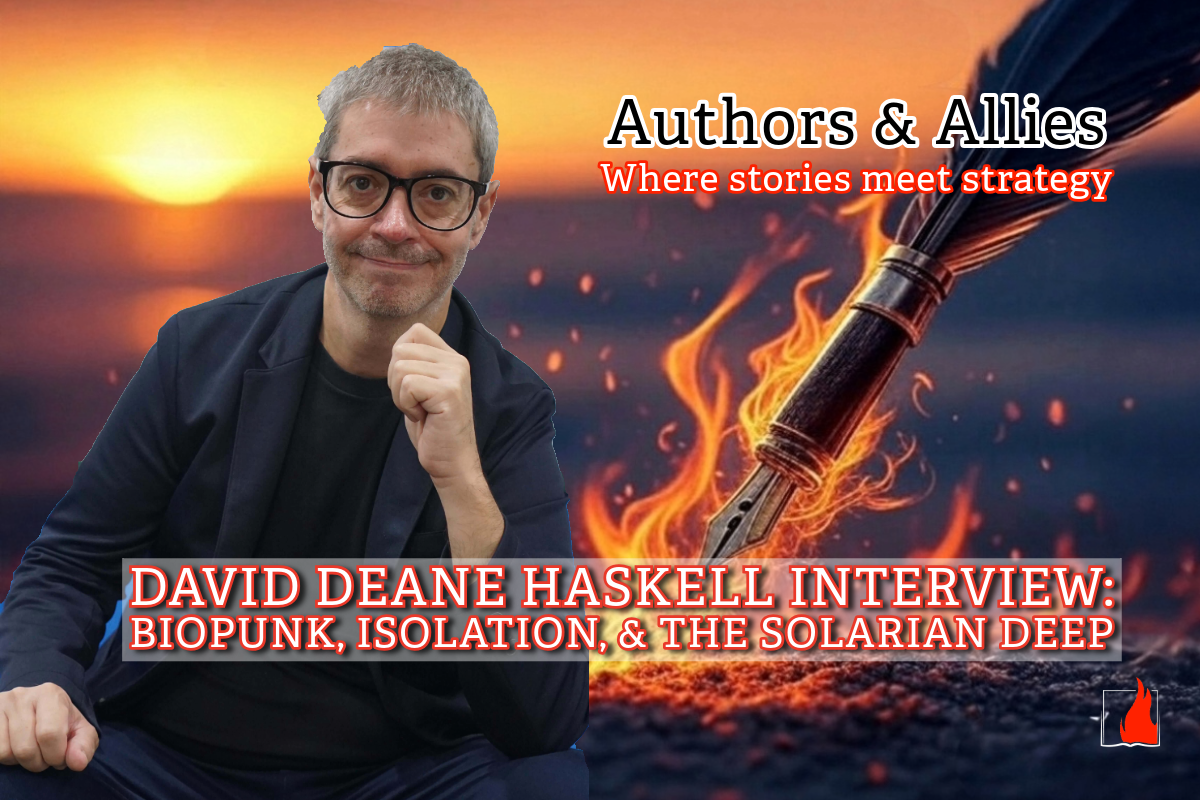
Welcome back to Authors & Allies, where we unpack the fascinating mechanics of speculative fiction and the business of independent publishing. Today, we are submerging ourselves into the crushing, claustrophobic depths of the ocean with David Deane Haskell.
David is an American writer currently living in Japan, and he is the visionary creator of The Solarian Deep—an atmospheric, underwater biopunk science fiction novel that sits at the intersection of first contact, psychological horror, and bodily transformation. The story forces radically altered human survivors to ask a terrifying question: when your body is reconstructed for survival in the deep, what still makes you human?
Now, grab a warm drink to stave off the ocean chill, and let’s plunge into the deep!

Interview with David Deane Haskell
The Feeling of Being “The Other”
Willy: Let’s dive right into the good stuff. You’re an American writer living in Japan, but The Solarian Deep plunges readers into a highly isolated, underwater biopunk setting. How has living in a different country and culture shaped your understanding of “isolation,” and what was the initial spark that made you want to set a sci-fi story in the crushing depths of the ocean?
David: I definitely have experienced the sense of being “the other”—the outsider, the outcast—which The Solarian Deep very much dives into. That feeling doesn’t just come from living in Asia as an American-born writer, but from other personal experiences too, like being bullied as a kid and facing childhood trauma, which I actually write about in my nonfiction books. Those experiences have certainly contributed to the sense of isolation in my fiction.
As for the initial spark to set the book undersea, I was originally just aiming to write a fairly lightweight mermaid book! I was serializing it on Royal Road and later on Substack. But as I wrote, the story naturally morphed into something with a lot more depth and weight.
Cyborgs in the Technoquatic Shallows
Willy: In our Authors & Allies series, we’ve explored different approaches to physical transformation—like Marcious molting in Dr. Joel Hamilton’s Mud Crab Kingdom to mirror emotional growth. In The Solarian Deep, your characters’ bodies are radically altered for survival. How do you approach writing about such extreme bodily changes? Is the transformation a physical manifestation of their psychological journeys, or is it pure, grit-your-teeth survival?
David: I approach some of these extreme bodily changes with an advanced evolutionary concept. This is a book set in the distant future, which gives me a cool advantage because things in the world and the universe have changed radically.
While the story started out in more of a fantasy realm, all the physical transformations in the finished book are strictly science-based, designed for a radically changed environment. For instance, we have “technoquatic“ enhancements which are high-tech, commercial upgrades. You pay for the upgrade, apply for the enhancement, and you get to become a bit of a cyborg—like having actual working gills implanted in your body. It allows me to weave a complex mix of the organic and the technological into the same storyline.
Overcoming the Echo Chamber
Willy: Your novel sits right at the intersection of first contact, body transformation, and psychological sci-fi. How do you balance these distinct subgenres? Is it a challenge to keep the vast, cosmic wonder of “first contact” grounded when your characters are simultaneously dealing with the intensely claustrophobic, psychological dread of the deep?
David: It is always a bit of a challenge when people ask me what specific niche or kind of sci-fi I write. I try not to niche down too much because I want my concepts to remain broad, and I don’t want to feel forced to write one way or another. Although the main characters are young adults and the book definitely appeals to that crowd, it’s really written for anyone who loves broad, visionary concepts.
I don’t think it’s that much of a challenge to balance the vast wonder of meeting “the other” with a psychologically oppressive, claustrophobic situation, because that is simply how our real world is. We encounter this “first contact” idea in everyday life.
I remember back in college, during the Cold War times, I ended up doing a music gig with a Russian troupe of dancers and musicians. The news was telling me every night that Russia hated us and war was imminent, so I was terrified they would all hate me. But they turned out to be absolutely lovely, charming, and nice people who were incredible performers. I realized I had been living in a psychologically condemning echo chamber. That real-world tension—and the way systems use fear to isolate us—is a major theme running throughout The Solarian Deep.

Building the Shallows Out of Real-World Decay
Willy: Building a convincing biopunk environment is no small feat. We recently spoke with debut sci-fi author Nmesoma Okechukwu, who recalled locking herself up and tearing through engineering textbooks to ground her work. What kind of research did you do to build the underwater ecosystem of The Solarian Deep, and how do you introduce complex biological concepts without slowing down the story’s momentum?
David: World building is an iterative process. I set this “technoquatic” society in an underwater city called The Shallows. It started out as a high-tech marvel, but over the years, it has become run down due to neglect and government negligence. You can see the physical and social decay creeping in.
I drew a lot of inspiration for this setting from my own travels and traveled extensively in Southeast Asia last year, and seeing those environments helped me visualize what a high-tech society looks like when it begins to decline.
I like to play with physical rules in my world building. In my third book, Dark Alignment, I wrote a dystopian disaster scenario where the laws of gravity suddenly shift. For The Solarian Deep, I wanted to combine the technological side of decline with radical, science-based biological changes, keeping it all as grounded and “real” as possible.

Where Stories Meet Strategy: Healing the Past, Facing the Future
Willy: Our series is all about where stories meet strategy. As book marketer Ashley Kelvin points out, one of the biggest hurdles for any author is simply “finding their tribe”. You have a unique online presence where you showcase both your visionary sci-fi fiction and your deeply personal nonfiction trauma-healing guides. What has your experience been like launching an unconventional, genre-bending novel, and how do these two very different sides of your writing connect?
David: Having my nonfiction inner child healing work alongside my cyberpunk science fiction on the exact same website is probably “crazy foolish” by traditional marketing standards! But to me, they are deeply connected.
My nonfiction examines the past and how we heal, while my forward-looking fiction is all about how we move forward together. The Solarian Deep reflects that duality: it features clashes, war drums, scapegoating, and hate, but it also carries hope, vision, and a sense of wonder for what might be.
My personal journey with trauma healing, addiction recovery, and inner child work has heavily informed my nonfiction, and that emotional depth naturally bled into the psychological journeys of my fiction characters. For me, finding my tribe comes down to doing organic outreach like this interview. If readers connect with my perspective on life and healing, they will find that same heart in my fiction.
Willy: That is a beautiful way to bridge the two. What’s next for you? Can we expect more stories soon?
David: Yes! I have two new books coming out this year that I am incredibly excited about. On the fiction side, I am launching a brand-new sci-fi series called The Resona Accords, starting with Book I, The Vibrants. On the nonfiction side, I am publishing a follow-up to my inner child healing book (Wounded Angels) titled Inner Child Unleashed. I hope we can chat again when they are out!
Willy: David, thank you for sharing your journey and taking us down into the beautiful, haunting depths of The Solarian Deep!
About David Daene Haskell:

David Deane Haskell writes how transformation feels—from trauma to healing, disconnection to self-return. His memoir Wounded Angels is a raw, intimate dive into despair, hopelessness, and the long road to peace. His fiction blends visionary imagery with the truths they reflect—where tech-heavy futures meet long-lost truths, and the loving heart always finds a way to short-circuit the machine.
Readers, don’t miss out on this spectacular underwater adventure. Go grab your copy of The Solarian Deep. Be sure to explore David’s healing work and keep an eye out for his upcoming releases at daviddeanehaskell.com!
Thank you for visiting with us. For more Bookish adventures or Literature related content, visit our blog at The Ritual. Copyright Mind on Fire Books.



Leave a Reply