
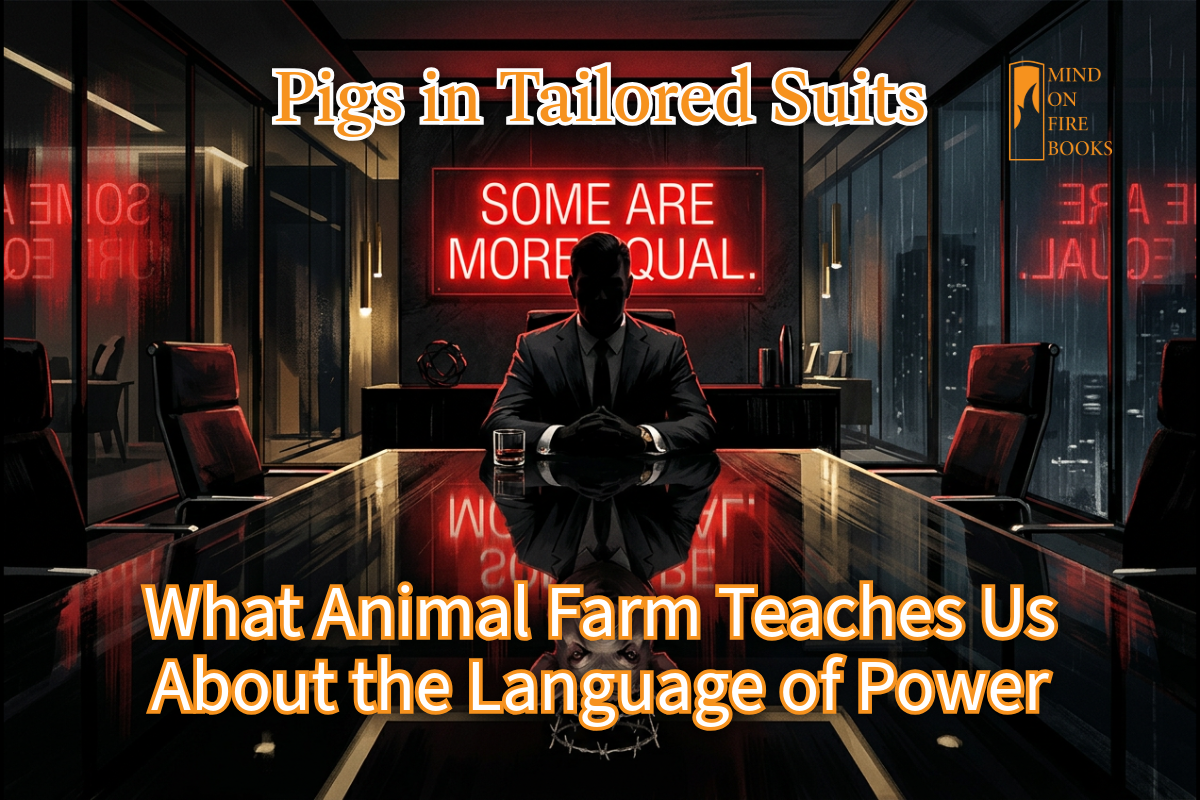
Power rarely arrives wearing a villain’s cape and cackling into the void.
It arrives holding a clipboard. It arrives behind a podium, wearing a smile, draped in the righteous language of “safety,” “unity,” and “the greater good.”
When George Orwell published Animal Farm in 1945, the world wanted to read it as a slick parody of the Soviet Union. But reductionist history misses the point entirely. Orwell wasn’t just dissecting Stalinist Russia; he was writing a timeless field guide to political manipulation. He was holding up a mirror to the exact mechanics of how idealists transform into tyrants.
If you’ve ever sat in a corporate room while a CEO rebranded layoffs as “structural agility,” or watched a politician rewrite yesterday’s promises with today’s doublespeak, you know the pigs didn’t stay on the farm. They just bought better wardrobe options.
Here are four Animal Farm quotes about power that slice through the noise, reveal the mechanics of control, and remind us why we must stay relentless in the pursuit of truth.
1. The Linguistic Gymnastics of Orwellian Equality
“ALL ANIMALS ARE EQUAL, BUT SOME ANIMALS ARE MORE EQUAL THAN OTHERS.”
The Autopsy
This is the holy grail of political hypocrisy. It is the ultimate logical contradiction, wrapped in the placid vocabulary of fairness.
Notice how the phrasing doesn’t outright repeal the original law of the farm (“All animals are equal”). Instead, it corrupts it from the inside out. Tyranny rarely burns down the institution; it guts the language until the words mean their exact opposite.
When authority figures claim to act in the name of the collective while quietly granting themselves exemptions, they are executing this exact playbook. It is the executive board voting for pay cuts while securing seven-figure bonuses. It’s the political elite instituting restrictions they have no intention of following themselves.
- The Lesson: Watch the adjectives. The moment someone adds a qualifier to a universal right, the right has already been stolen.

2. The Weaponization of Paternal Fear
“No one believes more firmly than Comrade Napoleon that all animals are equal. He would be only too happy to let you make your decisions for yourselves. But sometimes you might make the wrong decisions, comrades, and then where should we be?”
The Autopsy
Spoken by Squealer—the ultimate master of spin—this quote captures the sinister turn from leader to dictator. Notice the weaponized empathy. Napoleon isn’t stripping away your autonomy because he’s hungry for control; he’s doing it because he cares so much about your safety.
This is paternalistic authoritarianism in its purest form. It relies on a simple trade-off: give up your agency, and we will handle the anxiety of choice for you.
It turns critical thinking into a liability and blind obedience into a civic virtue. The moment a leader tells you that asking questions is dangerous to the community, they aren’t protecting you from chaos—they are protecting themselves from accountability.
- The Lesson: Benevolence that demands your silence is not benevolence; it is hostage-taking with better manners.
Based on your taste in literature, I think we could be good friends. Sign up below for the archive below and free eBook giveaways.
3. The Collapse of Nuance into Slogans
“Four legs good, two legs bad!” — later updated to: “Four legs good, two legs better!”
The Autopsy
When the sheep in Animal Farm are taught to chant this line, they aren’t being educated; they are being programmed. Whenever an awkward question or a difficult truth arises, the sheep simply bleat their slogan until all rational conversation is drowned out.
Complex problems require complex thought. But power hates complexity. Power thrives on binary tribalism: Us vs. Them, Good vs. Bad, Four Legs vs. Two Legs.
By reducing a nuanced political philosophy into a seven-word chant, the pigs erased the animals’ capacity for nuance. And when the pigs finally decided to walk on two legs, changing the slogan required only a single word swap. The chant stayed the same; the loyalty was simply rewired.
For a deeper dive into how language shapes critical thought, read Orwell’s seminal essay, Politics and the English Language.
- The Lesson: If your political or philosophical stance can fit neatly on a bumper sticker, you aren’t thinking—you’re chanting.

4. The Mirror of Moral Rot
“The creatures outside looked from pig to man, and from man to pig, and from pig to man again; but already it was impossible to say which was which.”
The Autopsy
The closing line of the novella isn’t just a burn—it’s an tragedy.
The revolution began with genuine passion, righteous anger, and a vision of liberation from human brutality. Yet, by the end, the new rulers had adopted every single habit, vice, and cruel efficiency of the oppressors they overthrew.
Power didn’t change the nature of the farm; it merely changed who held the whip.
This is the ultimate danger for any reformer, entrepreneur, or thinker. When you fight an entrenched system, the system fights back by trying to make you act like it. If your strategy for defeating a tyrant requires adopting their deceit, you haven’t won the revolution—you’ve just auditioned for the role of the pig.

The Spark: Fire in a Lukewarm World
Orwell didn’t write Animal Farm so we could sit back and feel intellectually superior to a farmyard full of fictional sheep. He wrote it as an alarm clock.
Don’t let the slogans think for you. Read deeply, question relentlessly, and keep your mind on fire.
Thank you for visiting with me. For more Poetry or Literature related content, visit my blog at The Ritual.




Leave a Reply