
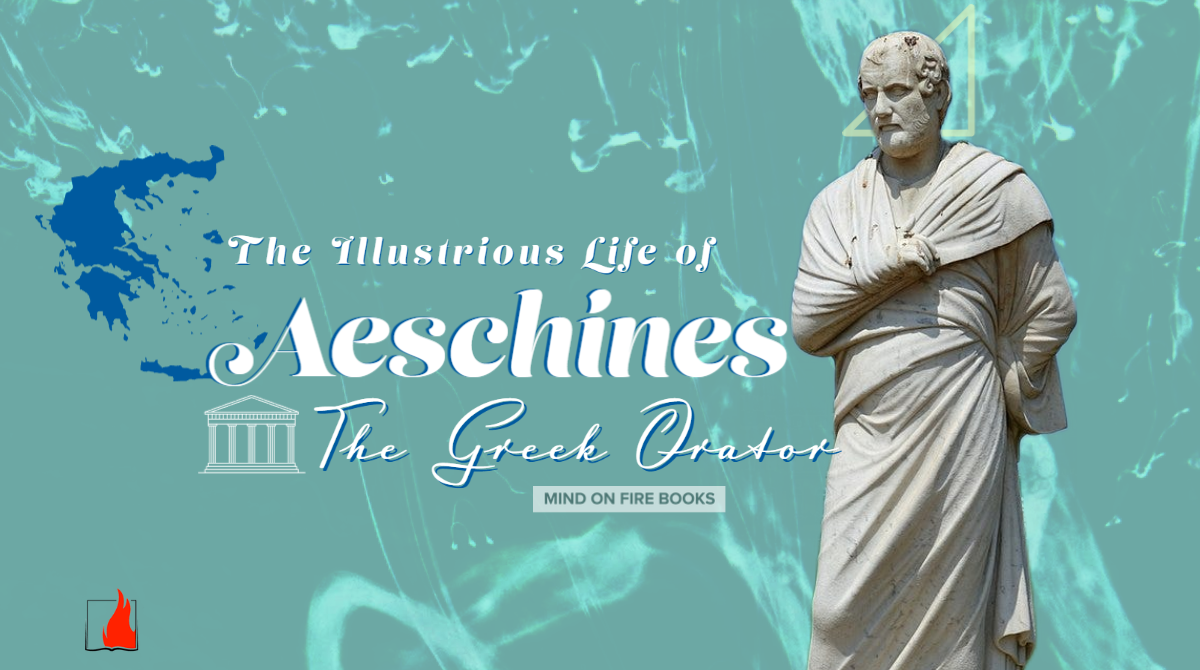
Aeschines 390-322 BCE (68 yrs of age)
Aeschines did not have the luxury of growing up with as many material possessions as the aristocrats. His father was one of the returning Democrats after the defeat of the Thirty. Aeschines grew up working with his father as a junior clerk and secretary to the assembly at Athens. He then went on as a tragic actor for a bit. However, he then decided to join the military.
At 28 years old, he began fighting at Mantinea and was still fighting seventeen years later. During this time, he would be decorated for valor at the battle of Tamnae in 348 BCE. Something interesting about his life before his career in oratory is that he didn’t study with any other philosopher or sophist of the day. Nor does he have an educational background.
Aeschines The Orator

This is when Aeschines enters the historical debates. He first debated against Phillip in 348. Later, he argues for peace with Phillip in 346. Aeschines was taken in by Philip’s friendliness towards Athens. However, Demosthenes saw it as bribery. Demosthenes begins their long duo by first taking Aeschines to court for treason in 343. However, Aeschines barely secured an acquittal and continues his career in the Senate.
In 339, Aeschines meets with the Council at the Apollo Shrine at Delphi. He manages to infuse a sacred war with the Thebans, an ally of Philip. Thebes was demanding a large sum of money from Athens. Aeschines was the Senator sent to repel this request.
Upon arriving, he makes no verbal response. He simply “pointed out with utmost vividness the land down below Delphi, visible from the site, which the Amphissians occupied illegally. He called emotionally for a sacred war to expel them.” This act of war allows Philip to return fire. Philip eventually defeats Athens in 339.
Here is where Demosthenes and Aeschines fight once again. Demosthenes blames Aeschines for losing the war. However, Aeschines holds his ground and blames “Demosthenes for preventing Athens from following up its advantage adequately.” Being on such good terms in the past, the senate chooses Aeschines to secure peace with Philip.
Aeschines Finally Gets His Revenge
Aeschines finally gets his chance at revenge on Demosthenes in 336 when he files a suit against Ctesiphon. However, the trial doesn’t meet until 330 BCE due to political transitions. It is unknown why Aeschines waited so long to retaliate. Moreover, it is unclear why he would want revenge after already beating Demosthenes in court. Nevertheless, he still tries because he believes that he should be the one receiving accolades . He is the one who made peace with the Macedonians after first attempting to build better relations with them.

Aeschines loses the trial so poorly that he failed to rally enough votes – one-fifth of the Senate – necessary to avoid a fine. To avoid the fine, and probably the humiliation after losing against Demosthenes, he leaves Athens for Asia Minor and Rhodes. It is speculated that he may have taught at either place. Philostratus (Roman rhetorician) later would regard him as the founder of the Second Sophistic.
There is no record of Aeschines’ actual death date. However, even though critics debate his loyalty to Athens, they all at least agree that he “ruined himself.”
Based on your taste in books, I think we could be great friends! Please sign up for the newsletter below:
The Grand Style in Oratory
Though he has no formal training, “he is familiar with commonplaces, argument, partition, and the devices of style as any Greek orator, and because of his experience as an actor, he probably knew more about delivery than most.” He is said to excel in the clear and vivid narrative. This narrative is contrasted with logical argument. His vocabulary is quite ordinary with the citizen of Attic, occasionally sprinkling hints of poetry or creativity. He uses exaggerated language to play up a scene. Additionally, he uses repetition and rhetorical figures with similar endings. His early career as an actor gives him the ability to quote poetry. However, he does not do it in a lengthy manner. It is short and concise.
In Against Ctesiphon, Aeschines is said to be quite funny in his language towards Demosthenes. He was not good at discussing broader issues. However, he is good at focusing on specific legalities of the case (Edwards 54). George Kennedy made note of the same focus on court legalities in the speech, Against Timarchus. In this, Aeschines solely focuses on the illegality of Timarchus. Interestingly, Aeschines does not talk about politics or policy, but he can still win the case by focusing on the illegal. Kennedy later posits a theory. He considers why it may seem like Aeschines purposefully avoided talking about politics.

Aeschines was walking a fine line between Macedon and Athens. He knew that whatever he said could be misconstrued to fit the rhetoric of war. We see this power he wields in being able to wage war when he provokes the sacred war. We can deduce that Aeschines was a confident man. His foreign and military experiences taught him that being fair is to focus on the law.
If you are enjoying this article, we have similar content studying communication from discourse theory, here.
When reading the introduction to Against Ctesiphon, we have to “imagine the speech delivered in Aeschines’ splendid voice and with the stance of a tragic actor.” Perhaps Aeschines’ grand style lay in his delivery. His surviving speeches are mainly concerned with case law.
What would other rhetoricians say about Aeschines? George Kennedy writes that “he loves to speak, and speaks for the moment only, without much historical responsibility. He is easily intoxicated by the exuberance of his own verbosity.”
And I think Quintillian, Cicero, and Plato would totally agree with Kennedy. Both Quintilian and Cicero would most likely immediately discredit Aeschines because of his lack of training or education. His mind has not been trained in the art of the sublime and loftiness. Plato would see his speeches as being epideictic, or, purely performances with no real conversation or knowledge.
Works: Aeschines was not a logographer. However, only three forensic speeches survive.
Against Timarchus 345 BCE, On the Embassy 343 BCE, Against Ctesiphon 330 BCE
Thank you for visiting with us. For more Reviews or Literature related content, visit our blog at The Ritual. Copyright Mind on Fire Books.





Leave a Reply