
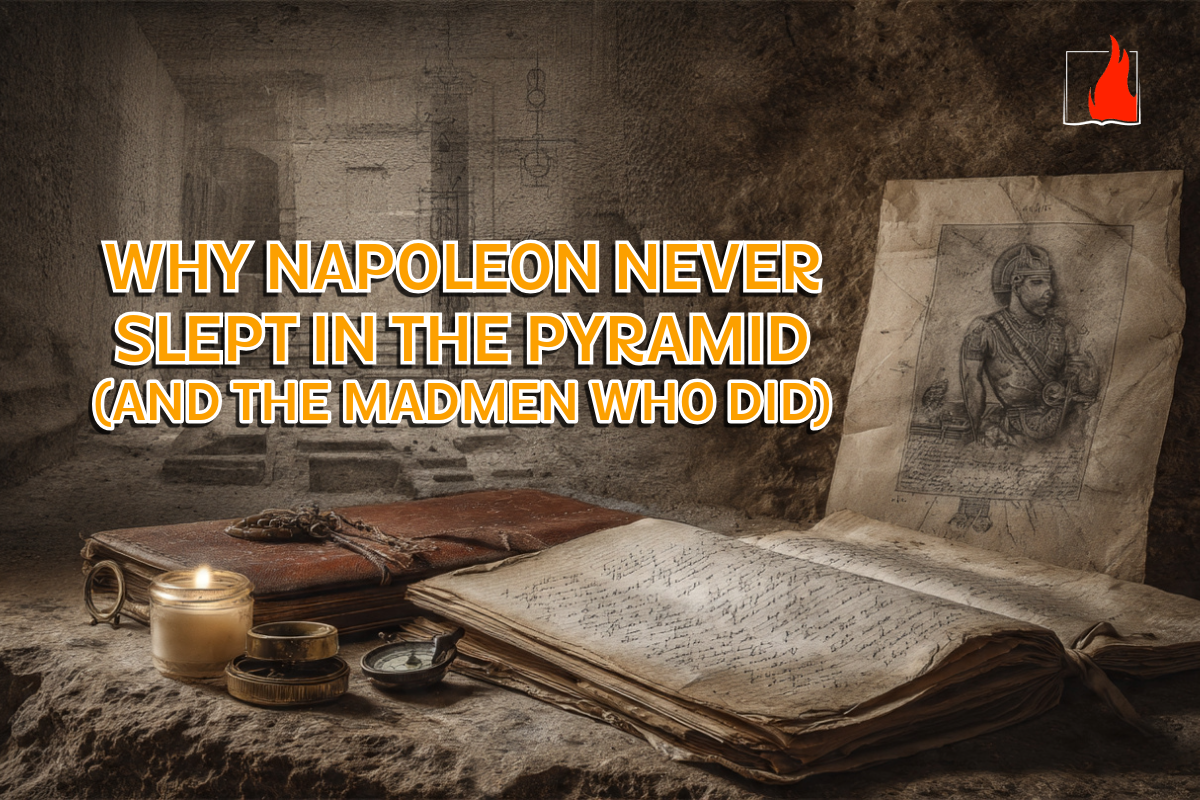
It is one of the most cinematic moments in occult history: August 1799. The question, did Napoleon sleep in the Great Pyramid, still fascinates historians and enthusiasts alike. Napoleon Bonaparte, the future Emperor of France, orders his men to leave him alone inside the King’s Chamber of the Great Pyramid of Giza.
He spends the night in the crushing darkness of the tomb. When he emerges the next morning, he is pale, shaken, and refuses to speak of it. Years later, on his deathbed, he almost reveals the secret to a friend but stops short, muttering, “What’s the use? You’d never believe me.” It is still debated: did Napoleon really sleep in the Great Pyramid or not?
It is a perfect story with atmosphere, mystery, and a touch of cosmic horror—no wonder people keep asking whether Napoleon found rest within the Great Pyramid.
There is just one problem: It almost certainly never happened. This is despite what popular theory websites have produced, such as the Ancient Code.
If we want to tell a story about the “exotic and occult experience” of the Great Pyramid—and we definitely should—we need to separate the Victorian myths from the terrifying reality. This kind of story explores the legend of Napoleon sleeping in the Great Pyramid.
Based on your taste in literature, I think we could be good friends. Sign up below for the archive below and free eBook giveaways.
The Debunk: Napoleon’s Empty Night
The source of the “pale and shaken” legend is hard to pin down, often cited in later romanticized biographies. However, the mystery surrounding whether Napoleon slept in the Great Pyramid is debunked by a specific account.
Louis Antoine de Bourrienne, Napoleon’s private secretary who was glued to his side during the Egyptian campaign, wrote explicitly in his memoirs that the General never entered the crypt.
According to Bourrienne, while other members of the expedition climbed the pyramid or ventured inside, Napoleon remained outside, amusing himself by challenging his staff to a race to the top. The tale of Napoleon sleeping in the Great Pyramid was likely a myth cultivated later. It was used to draw parallels between Napoleon and Alexander the Great (who also allegedly, but likely historically didn’t, sleep there).
Napoleon knew the value of good PR. Being seen as a mystic conqueror communing with Pharaohs was better for his brand than the reality. In reality, he was a tired general waiting in the sand for his mathematicians to finish measuring stone blocks. He did not actually sleep in the Great Pyramid like the legend claims.

The True Psychonauts of the King’s Chamber
While Napoleon may have stayed outside, other historical figures did brave the dark. Unlike the rumors about Napoleon, these individuals truly slept in the Great Pyramid’s King’s Chamber. Their experiences provide the exact kind of “occult” fuel you are looking for in a short story.
The King’s Chamber is a sensory deprivation tank built from 4,000-year-old granite. It is dead silent. When the lights go out, the human brain—starved of input—begins to hallucinate. That isolation makes one wonder what Napoleon might have experienced if he really did sleep in the Great Pyramid.
Here are the two men who actually faced the void, unlike Napoleon. For Napoleon, the story of sleeping in the Great Pyramid remains a myth.

1. Paul Brunton: The Horror of the Void (1930s)
If you want to write a story about the fear of the pyramid, look at British philosopher Paul Brunton. His book, A Search in Secret Egypt, contains a chapter titled “A Night in the Great Pyramid” that reads like lovecraftian fiction. That sort of direct experience—actually sleeping in the Great Pyramid, not unlike the story of Napoleon—offers rich material for the imagination.
Brunton bribed the guards to let him stay overnight. He describes sitting in the total darkness until the silence became “heavy” and “alive.”
- The Experience: He didn’t see angels immediately. He describes being surrounded by “hostile creatures” and monstrous, dark shapes that circled him, filling him with an overwhelming, primal terror.
- The Climax: According to his account, the fear eventually broke, and he was visited by two “Good Spirits” (high priests) who offered him an initiation, leading to an out-of-body experience where he saw the pyramid’s true history.
The Writer’s Takeaway: Brunton’s account is perfect for a psychological horror angle. The “monsters” he saw are classic manifestations of the Shadow Self. The pyramid acts as a mirror; if you bring fear in, the chamber amplifies it. The legend of Napoleon sleeping in the Great Pyramid pales compared to these real experiences.

2. Aleister Crowley: The Magician’s Honeymoon (1904)
If Brunton brought fear, the infamous occultist Aleister Crowley brought arrogance. Crowley, unlike Napoleon, really did spend a night inside the Great Pyramid, challenging the legends surrounding Napoleon’s supposed night there.
- The Experience: In 1904, while on his honeymoon, Crowley and his wife Rose spent a night in the King’s Chamber. Crowley donned his ceremonial robes and read a magical incantation by the light of a candle. He famously described the candle flame as a “dirty yellow blasphemy” against the “astral light” that he claimed illuminated the room.
- The Result: This night was the precursor to his reception of The Book of the Law a few days later in Cairo, the text that founded his religion, Thelema.
The Takeaway: Crowley’s experience wasn’t about surviving the dark; it was about dominating it. A story about a character who goes into the pyramid not to learn, but to take power, would align with this energy. This kind of story would explore the idea of whether sleeping in the Great Pyramid transforms a person, as is rumored of Napoleon.

Is This Worth a Story?

Absolutely.
The contrast between the romantic expectation (Napoleon’s “secret wisdom” gained by allegedly sleeping in the Great Pyramid) and the sensory reality (Brunton’s “creeping terror”) is a goldmine for fiction.
A Flash Fiction Prompt for You:
A protagonist enters the King’s Chamber expecting to meet the ghost of Alexander the Great. Instead, the absolute silence causes them to hear the one thing they’ve been running from: their own heartbeat. The “ghosts” they see aren’t ancient Pharaohs—they are the memories of everyone they have ever wronged.
The pyramid doesn’t give you what you want. It gives you what you are. And so, the true mystery remains—did Napoleon, in fact, sleep in the Great Pyramid, or is the legend itself the greatest fiction of all?
Thank you for visiting with me. For more Pop Culture or Literature related content, visit my blog at The Ritual. Copyright Mind on Fire Books.
If you enjoyed this article, you might also enjoy these articles:
Thank you for visiting with me. For more Poetry or Literature related content, visit my blog at The Ritual.



Leave a Reply